
Everything You Didn't Know About Knitwear
KNITPEDIA
An Illustrated Guide to the Differences Between Knitted and Woven Fabrics (Elasticity, Uses, Manufacturing Methods)
How Pills Form

Knits develop pilling because the fibersThey become entangled due to friction and rise to the surface, where they solidifyThis is the reason.
Pilling is particularly likely to occur under the following conditions.
The fibers are long and thin→ Prone to slipping due to friction (wool, cashmere, etc.)
Contains synthetic fibers→ Because they are resistant to friction, the fibers don't break but instead curl up and form pills (acrylic, polyester, etc.)
Highly Mobile Parts→ Cuffs, underarms, sides, areas where the bag rubs against the body, etc.
Pills tend to form due to "friction, heat, and force."
How Prone to Pilling Different Knit Fabrics Are

Acrylic blend: It's inexpensive, but pilling is noticeable.
Polyester blend: Durable, but prone to pilling
Cashmere: It is very soft and prone to pilling, but with proper care, it will last a long time.
100% Wool: It does develop mats, but they come out easily when brushed
Woven Fabrics vs. Knitwear: Which Is More Prone to Pilling?

To put it simply, knit fabrics are more prone to pilling than woven fabrics.
1. Differences in Structure
Knitwear
Because it is knitted in a looped pattern, the yarn tends to shift easily, causing the surface to become fuzzy.
When lint gets tangled due to friction, it turns into a ball of lint.
Woven Fabrics
The warp and weft threads intersect at right angles, making it easy to secure the threads.
It is less likely to develop surface fuzz and is resistant to pilling.
2. Properties of the Thread Used
To give knitwear softness and stretch,Thin, pilling-prone yarns and yarns containing synthetic fibersis commonly used.
To give woven fabrics body and strength, they are relativelyYarn with tight twist and minimal fuzzThere are many.
3. Friction While Wearing
Because knitwear fits snugly against the body and moves with you, it’s prone to friction in areas such as the underarms and sleeves.
Although woven fabrics can restrict movement, the frequency and intensity of friction are relatively low.
Summary
Prone to Pilling
Knitwear > Woven FabricsPilling is particularly noticeable on knitwear made of wool or acrylic blends.
In the case of woven fabrics that are prone to pilling due to a raised-pile finish (such as flannel), pilling may occur, but generally not to the same extent as with knits.
Types of Knitwear Prone to Pilling, Ranked (Approximate)
The ball of yarnVery easy to make (Large)
Acrylic Knit
→ Synthetic fibers are so strong that they don't break, so they curl up due to friction and leave behind pilling. This is common in inexpensive sweaters.Cashmere Sweater
→ Because the fibers are very fine and soft, they easily become fuzzy and develop pills due to friction. However, they are easy to care for with brushing.Wool and Acrylic Blend
→ The combination of wool's tendency to fuzz and acrylic's tendency to leave fibers behind results in a lot of pilling.
The ball of yarnRelatively easy to make (Medium)
100% Wool Knit (Merino Wool, etc.)
→ While pilling does occur, wool fibers break easily, so they may fall off naturally, leaving fewer pilling residues than acrylic does.Knitwear Made from Animal Hairs, Such as Angora, Mohair, and Alpaca
→ The long, soft, fluffy fibers tend to get tangled and form mats. While it looks luxurious, it’s hard to avoid matting.
The ball of yarnHard to do (Small)
Cotton Knit
→ Since it’s made of short fibers, it does pill to some extent, but less so than wool or acrylic. The pills come off easily in the wash.Linen-Silk Blend Knit
→ It has a smooth surface and is resistant to pilling. It is also relatively resistant to friction.Nylon-Blend (Small Amount) Knit
→ Nylon is strong, but adding a small amount can improve durability and may also reduce pilling.
Summary (In Order of Likelihood of Pilling)
Acrylic > Cashmere > Wool/Acrylic Blend > 100% Wool > Angora/Mohair > Cotton > Linen/Silk Blend
There are also differences depending on the knitting method.

Loose-knit (coarse knit)→ Because the yarn is thick and creates a lot of friction, it tends to pill easily.
High-gauge (fine knit)→ Because the yarn is tightly packed, it is less likely to shed and less prone to pilling.
Pilling Prone Matrix (Fabric × Knitting Method)
Even if a clothing label says “knit” or “woven,” few people may be able to accurately explain the difference between the two.
In this article,Differences in Fabric Structure, Characteristics, and UsesWe'll explain this in an easy-to-understand way, using diagrams and photos.
To begin with, what's the difference between "knits" and "woven fabrics"?
"Knit" and "woven" fabrics are both made from yarn, butThe structure is completely different.
Knit fabric is made by knitting yarn into loops. Because each loop is connected to the next, when you pull on it, the loops stretch out,Stretches well and snaps back into shapeIt has the following characteristics. Because it is soft and naturally conforms to the body’s movements, it is often used in clothing that requires ease of movement, such as T-shirts and sweaters.
On the other hand, since textiles are made by interlacing warp and weft threads at right angles, they have a sturdy structure, andResistant to stretching and maintains its shapeIt maintains its shape. Therefore, it is well-suited for clothing that requires a neat and polished look, such as suits and shirts.
In other words, even though they're both "fabric,"Knitwear derives its softness from the process of “knitting,” while woven fabrics derive their strength and stability from the process of “weaving.”That's right.
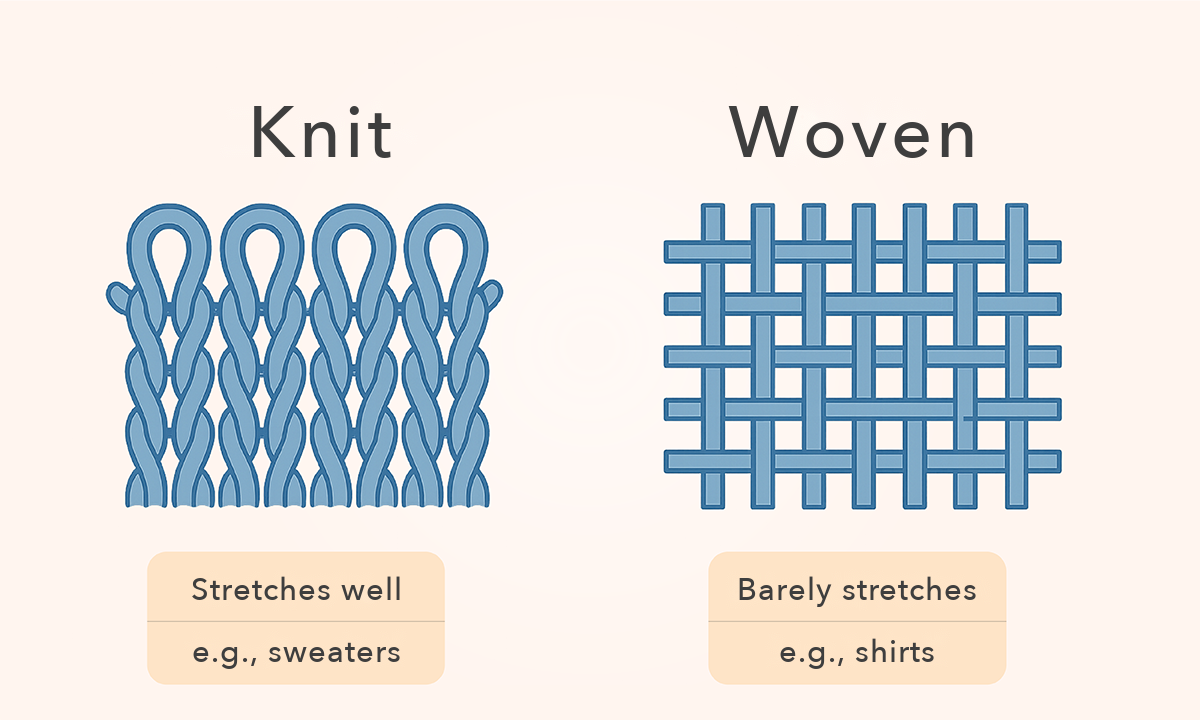
Characteristics of Knitwear — The Stretch and Softness That Come from “Knitting”
The most distinctive feature of knitwear is,High elasticity and softness.
Thanks to its looped structure, it stretches well both vertically and horizontally and has the elasticity to snap back into place with every movement.
For this reason, it is often used in items that fit closely to the body, such as casual wear, sportswear, and undergarments.
Another appealing aspect is that the type of knit—such as jersey, rib, or terry—significantly affects the fabric’s breathability, thickness, and texture. Because it is shaped using a single strand of yarn, it offers a high degree of design flexibility and can be described as a “fabric that easily brings out the yarn’s unique character.”
Characteristics of Woven Fabrics — Stability and Strength Achieved Through “Weaving”
Since textiles are made by tightly interlacing warp and weft threads,Retains its shape well and is resistant to stretching...is its defining feature.
As a result, it also has the advantage of being easy to iron and smooth out wrinkles.
In addition, depending on the weave (plain weave, twill weave, satin weave, etc.), the surface luster and texture vary, and patterns and designs can be accurately reproduced.
Suit fabrics, denim, and other materials,The longer you use it, the better it gets.It comes in a wide variety of materials and is highly valued for formal wear and items that require durability.
Uses and Recommended Items
Differences in Structure Determine “Impression and Function”
Knitting using a loop structure →Stretchy, Soft, and Easy to Move In
Textiles = interlacing threads →Sturdy, retains its shape, formal
Understanding fabric structures is the first step in choosing clothes. “What kind of occasion will I be attending today, and what kind of movements will I be making?”—By choosing a fabric that fits the answer to that question, your clothes will be more comfortable and truly reflect your personal style.
Fun Fact
・What is a knit top?
The term “katsuso” comes from “cut & sew,” meaning “to cut and sew.”
In other words, the knit fabric used for T-shirts and other items is,Clothing made by cutting and sewing knit fabricThat's what it means.
Even though it may look like woven fabric, it’s often actually knit.
・What is "Fuhaku"?
"Fuhaku" is a general term for woven fabrics.
By referring to "knits" as "woven fabrics,"A sturdy, non-stretch woven fabricrefers to.
It’s helpful to remember that shirts, slacks, and other items that “hold their shape” are made of woven fabric.
If you'd like to learn more,
The content of this article has been independently edited and organized using research and AI. For those who wish to learn more about the properties of textiles and clothing care in greater depth, we recommend consulting a specialized institution such asJapan Clothing Management Association (General Incorporated Association)Well,
Text widely used in the industryBasic Knowledge of Textile Products (Newly Revised Edition), 3-Volume SetThis may be helpful.
This resource provides a systematic overview of fiber structure, material properties, and handling methods.
Glossary | Page (Part 1) | Contents | |
|---|---|---|---|
Types of Textiles | Plain weave, twill weave, satin weave | p.54-p.59 | Types and Properties of Fabrics, etc. |
Types of Knitting | Horizontal Knitting, Vertical Knitting, Classification of Knitting Machines, Knitting Structures | p.62-p.72 | Classification and Formation of Knitwear |
/ Tag
Return to KNITPEDIA Home