
Learn About the Participating Companies
LISTEN

This means that Naigai has been entrusted with the “footwear” for a top brand.
Interview with Kenji Imaizumi of Naigai Co., Ltd.
A Closer Look at a Japanese Sock Master Who Has Built a Legacy of Trust Spanning Over 100 Years

From NAIGAI STYLE
Ralph Lauren, Calvin Klein, Lanvin, Tommy Hilfiger. Did you know there’s a Japanese company that has consistently supported the “footwear” of these world-renowned, top-tier brands? Its name is Naigai Co., Ltd. Founded over 100 years ago, the company has made a name for itself worldwide by specializing in “socks”—one of the most demanding categories within the knitwear industry. Subject to repeated stretching and contracting, absorbing sweat, and requiring a shape that never loses its form—this is truly the “battlefield of knitwear,” where both fashion and durability are demanded simultaneously. In this world of footwear, Naigai has consistently remained the “go-to choice.” Why exactly do these renowned brands choose Naigai? To explore the company’s technology, philosophy, commitment to materials, and vision for the future, we spoke with Kenji Imaizumi, President and CEO of Naigai Co., Ltd.
But first, let me explain a little about why Naigai was chosen.
Socks Are at the “Forefront of Knitwear”: The Rubber Yarn Called “NDX” at the Heart of the Technology

NAIGAI / RONDEX FACTORY (NDX Manufacturing Plant)
Socks are a type of “knitted garment,” just like sweaters and cardigans. However, their design requires a completely different level of precision. The number of times they stretch and contract, their resistance to sweat and friction, and their ability to stay in place without being too tight or slipping down— Worn every day, walked in, and washed repeatedly, socks are where “hidden functionality” is put to the test. That is what socks are all about. Simply “knitting” them isn’t enough. It requires technology that “withstands movement and retains its shape.” For over 100 years, Naigai has continued to confront these harsh conditions at our feet.
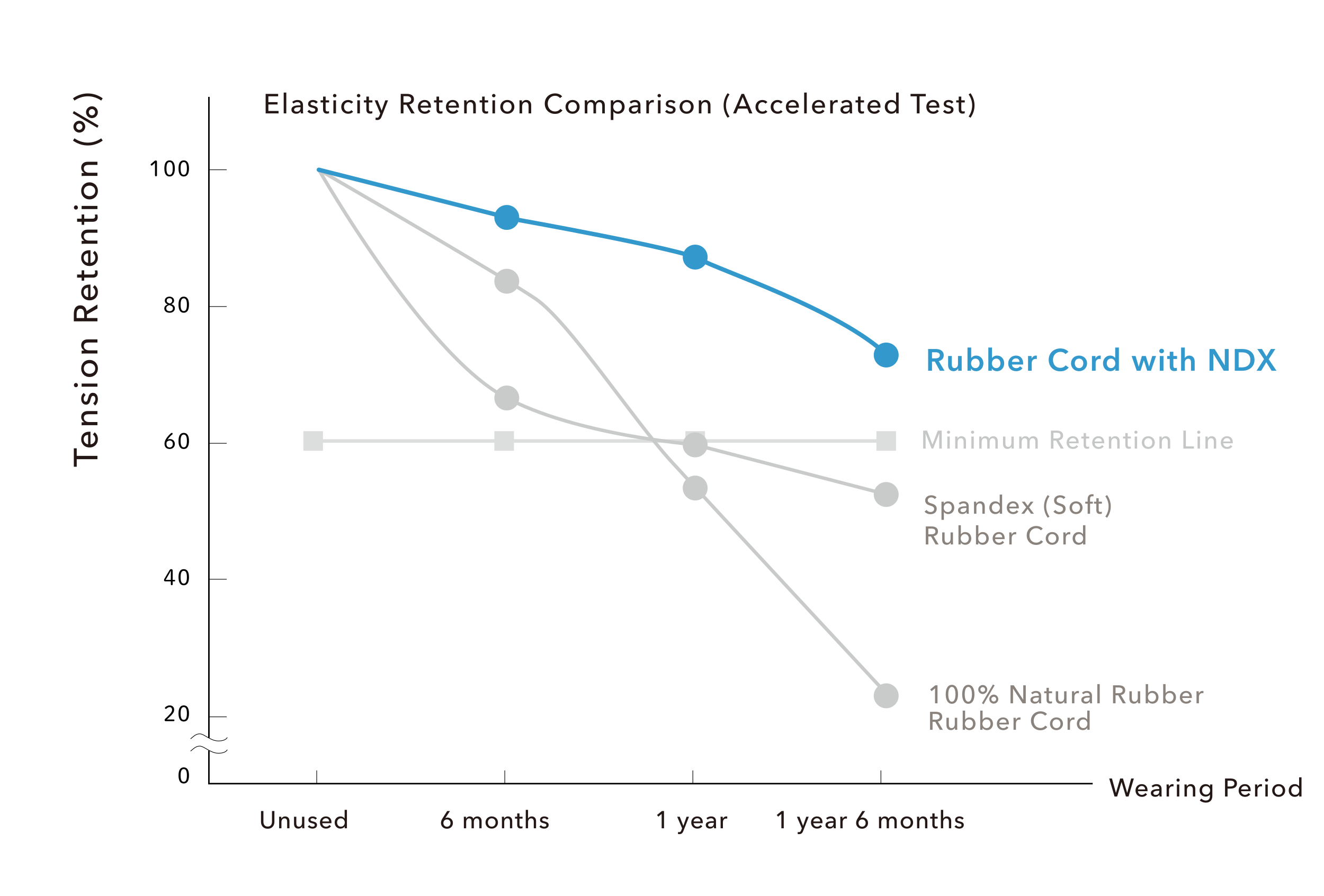
One of the secrets behind this is “NDX,” a high-performance rubber yarn developed in-house by Naigai in 1977. While people often assume all rubber is the same, it’s actually a crucial material for socks—it determines the fit at the cuff and the overall durability. Naigai understands the distinct characteristics of both natural and synthetic rubber, and has succeeded in creating a material that is resistant to degradation from UV rays and washing, while also offering comfortable elasticity that doesn’t feel too tight. The result is this NDX. If you look at the graph above, you’ll see that it maintains a particularly high level of elasticity over time. In fact, we frequently hear feedback that socks made with NDX resist sagging even after dozens of washes and show little deterioration even when air-dried outdoors. It is this attention to detail in these “invisible parts” that has earned the brand its reputation for reliability.
With its original brand, the company offers a full range of products, from sports to fashion. Its strength lies in having its own “testing ground” for socks.


What sets Naigai apart is not only its technical expertise, but also the fact that it has its own facilities where it can test that expertise in real-world conditions. Under its own brand, the company offers a wide range of product lines, as shown below.
NAIGAI COMFORT: We strive for the ultimate in comfort and address the diverse foot concerns of every individual.
NAIGAI PERFORMANCE: Supports foot movement to help you enjoy sports like running even more
NAIGAI STYLE: A design series that adds a touch of glamour to your look while keeping design and trends in mind
NAIGAI TRADITIONAL: A Hall of Fame item that has been a long-time bestseller for over 10 years
Creative Thinking That Looks Beyond the Sock: "Socks You Don't Wear"

Recently, we developed a completely new product called “Hakanai Kutsushita”—a product that can be worn directly in mules, pumps, loafers, and sandals; is washable just like socks; and offers superior moisture-absorbing capabilities not found in regular insoles. This product, which meets the demand for wearing shoes barefoot, generated a huge response after being featured on a TV show, leading to a surge in traffic to our e-commerce site immediately following the broadcast. It became so popular that items were frequently sold out.
Naigai: At the Intersection of Fashion and Function
Socks designed to be seen, socks made for sports and other functional purposes, and socks you’ve never even imagined—they’re more than just disposable items. While they’re part of an outfit, they’re also designed to help you get through the day comfortably. They’re items where fashion and functionality coexist in perfect harmony. Naigai has navigated this complex landscape by catering to every need—from department stores and mass retailers to brand OEMs and its own product line. As the editorial team, we’d love to hear about what the future holds.
Well, we had the opportunity to speak with Mr. Imaizumi, the president of Naigai, about a variety of topics.

Thank you for taking the time to speak with us today. The editorial team has compiled a list of questions we’d like to ask, so please feel free to answer them candidly.
Q Why did Naigai start manufacturing socks in the first place?
A sock manufacturer with the same origins as Morimura-gumi
The origins of Naigai date back to our founding in Taisho 9 (1920). At that time, there was virtually no “sock industry” to speak of in Japan; socks were almost exclusively imported from Europe and the United States. Moreover, many of these imports were of poor quality and did not fit Japanese feet properly. Seeing this situation, our founders, Koichi Yoda and Masakazu Kobayashi, resolved to “make socks with our own hands—socks made for Japanese people and tailored to fit them.”
These two individuals originally worked at the New York branch of the Morimura Group (Morimura Brothers). Morimura-gumi was an organization that served as the origin of manufacturing companies—in other words, a group that supported Japan’s modern industrial sector. Having learned the business within that environment, they understood firsthand the value of not simply selling products, but of “creating products that enrich people’s lives with their own hands.”
At that time, there were few machines for knitting socks in Japan, so the company procured machinery from overseas and paved the way for domestic sock production from scratch. Moreover, rather than simply replacing imports, the company aimed to “provide products that are durable, comfortable to wear, and reasonably priced, and to serve people all over the world.”
So, if asked why they continued to make socks, I believe the answer isn’t simply “because there was a market for them,” but rather that it was the result of the founders’ aspiration—to “create with our own hands the things that are truly essential to Japanese daily life”—combined with the historical context of the time.
Socks are certainly not the stars of the show. But since we wear them every day, how comfortable they are can make or break a person’s day. That is precisely why I believe Nagai has remained sincerely committed to socks for over 100 years, and we intend to uphold that commitment moving forward.
Q I'm very interested in NDX, a proprietary material you've developed. Could you tell me more about the technology behind it and how it's being applied in various fields?
A level of comfort that spandex just couldn't provide
When it comes to socks, “comfort” depends more on this elastic thread than on their appearance. In fact, socks in the past didn’t use elastic thread at all. Back then, it was common for socks to slip down or become wrinkled while wearing them. Amidst this, Nagai was one of the first to develop an innovative technique: “inserting elastic into the sock and knitting it in at the same time.” This was a completely new concept at the time—a technology that could have easily been patented and kept exclusive.
In light of this, we at Naigai have independently developed NDX, a rubber yarn material that is ideal for sock cuffs. We have developed a unique technology for blending liquid natural rubber and synthetic rubber—a process that cannot be replicated by other companies—and the material is manufactured by our group company, Rondex Thailand.
The most notable feature of NDX is that it is significantly softer and more supple than conventional spandex. Furthermore, it maintains this softness while offering the durability to withstand repeated washings.
Furthermore, this NDX material is not only being used in the elastic waistbands of underwear, pajamas, and other outerwear, but its application is also expanding into the medical and nursing care fields—such as in skin-friendly support garments and medical compression stockings. As a result, it is evolving from a mere material for socks into a “platform that meets the needs of various aspects of people’s daily lives.”
As a sock manufacturer, we can contribute to solving societal challenges through the materials we use. I feel that we are now entering a new phase in this journey.

From NAIGAI STYLE
Q Could you tell us why so many top brands trust you, and what it means to maintain your own brand?
Naigai Standard (NIS)
Over the years, we have built relationships of trust with various brands both in Japan and abroad. In particular, our partnership with the Ralph Lauren brand has continued for about 40 years.
At one point, as part of a project for the Ralph Lauren brand, we had an idea: “We’d like to try making socks like this.” However, at the time, there were no knitting machines capable of meeting those specifications. So we consulted with a machine manufacturer, and they developed a new machine specifically designed to knit those socks. As a result, a machine capable of handling those special specifications was completed, and we were able to install it in our factory and begin full-scale production. I believe it is this kind of commitment, among other things, that has earned us trust in terms of technology and quality.
We have a technology development center in Morishita, Koto Ward, Tokyo, and our quality control operations are registered with the JNLA (Japan National Laboratory Accreditation) as a public testing organization.
We have established our own quality standard called NIS (NAIGAI INDUSTRIAL STANDARD), and we strictly enforce the same standards not only within our company but also at our partner factories. These checks involve detailed inspections from a perspective that closely mirrors real-world use—such as changes in appearance and fit after washing—and may even include dozens of wash tests. We also conduct tests for colorfastness, durability, and safety. Through these standards, we have established a system that ensures “Naigai Quality” is delivered no matter where the products are manufactured.
I also feel that continuing to operate our own brand—in addition to our OEM and licensing activities—is of great significance. By directly experiencing customer reactions and feedback in stores, we refine our own sensibilities, and this, in turn, is applied to our OEM products. I believe this cycle underpins the overall quality of our manufacturing.
Socks may be a small product, but they are also an item that clearly reflects a brand’s values and vision. To ensure our products enhance that vision without compromising it, we are committed to continuing our careful and sincere craftsmanship.

Q It’s very interesting that Naigai, which used to operate its own factories, has now outsourced manufacturing and is focusing on product development and raw material development. Could you tell us how you came to adopt this new structure?
Beyond the Era of Mass Production: Naigai’s Reassessment of Its Role
There was a time when we actually owned our own factory and handled all of our sock production in-house. Of course, if everything ran smoothly, that might be the most profitable option.
Customer needs are no longer centered on mass consumption as they once were, and distribution channels are becoming increasingly fragmented. As a result, a business model based on “handling everything in-house from start to finish” has simply ceased to be a good fit for our company.
Therefore, rather than insisting on in-house production, we have shifted to a system where we focus on planning, design, and raw material development while working closely with our partner factories. For example, we are actively developing proprietary materials such as NDX, and we are also working to ensure consistent quality standards across our domestic and overseas factories based on our proprietary NIS quality standards.
When we say we’ve outsourced production, some people might think we’ve “stopped doing it ourselves,” but we actually believe that we’ve come to take even greater responsibility for the “essential aspects” of manufacturing—why we make this product and what value we infuse into it.
I feel that it is important for us to thoroughly reevaluate our roles in light of the changing times and consider how we can demonstrate our value within that context.
Q: How do you share value with partners such as manufacturers and retailers? There are upstream, midstream, and downstream segments—could you explain the role and significance of the midstream (wholesale) segment for Naigai?
A "Thoughtful Wholesaler" That Goes Beyond Planning to Development
For many years, we have served as a so-called “middleman,” fulfilling the role of a wholesaler. I still vividly remember what my boss told me when I was young: “Being a wholesaler isn’t just about moving goods—it’s about understanding the philosophy and values behind them and conveying that clearly to the other party.”
What motivates manufacturers and factories—the “upstream” players—to create their products? What do retailers and customers—the “downstream” players—want? I believe our job is to act as a bridge between these two sides, understanding both perspectives, and to facilitate coordination and make recommendations.
When we propose to our partner factories that “we’d like to work together to create products like this,” there are times when we purchase the machinery ourselves and then lend it to them. In a sense, some of our collaborations take the form of a lease arrangement. Since investing in machinery is a significant financial burden, we hope that by providing the necessary infrastructure, we can build relationships that allow us to create valuable products together.
In recent years, there has been an increase in cases where brands sell directly to consumers, but precisely because of this, I feel that the role of maintaining relationships from a wholesaler’s perspective and ensuring overall balance is still very meaningful.
Furthermore, at Naigai, we are often involved in the upstream stages of the process, such as product planning and design; as a result, we position ourselves not merely as a “middleman,” but as a wholesaler that takes an active role in the development process.
We now live in an era where distribution and sales channels have become increasingly diverse, and roles are no longer fixed. In this environment, we aim to be a company that effectively communicates and delivers value while leveraging our unique position and strengths.

Q Finally, could you tell us about the vision Naigai is striving toward and your thoughts on the future of socks?
I Want to Help Socks “Rise to Prominence”—From Everyday Items to Pillars of Society
As we often discuss within the company, I really do want to help socks “climb the corporate ladder.” Socks are often viewed simply as everyday items or consumables, but I want to raise their value even further. I feel strongly about conveying the intrinsic value of socks themselves.
I believe that in the future of the sock industry, it will become increasingly important to balance functionality with emotional appeal, rather than treating socks as “mere clothing.” Beyond comfort and wearability, I believe the value of socks lies in their ability to promote health and provide a sense of “well-being” and “satisfaction” in our daily lives.
In particular, as the population ages and birthrates decline, there is a growing need for socks that support health from the ground up. I strongly believe there is a good chance that society will gradually come to recognize socks as an important factor in maintaining health.
Socks as a fashion item are also changing.
In the past, black, white, and navy were the main colors, but nowadays, it has become commonplace for people of all ages and genders to show off and enjoy wearing socks.。
I think that in the future, socks as a means of self-expression will become even more widespread.
At Naigai, we intend to continue leveraging both our technical expertise and our creative planning capabilities to offer socks that enhance people’s daily lives. We aim to do more than simply manufacture products; we hope to create value in a wide range of areas—including health, fashion, the environment, and community engagement—through our socks.
To that end, while continuing to cherish our founding philosophy of “serving others,” we also intend to remain flexible in adapting to the changing times. For example, we have already begun initiatives such as digital sales, AI-powered analytics, and the development of ESG materials.
And, of course, we want to be a company where every single employee takes pride in their work. After all, a company is ultimately about “people,” so I believe that creating an environment where employees can grow and find fulfillment in their work will ultimately lead to contributing to society.
I also have something I’d like to share with the younger generation. To be honest, the sock industry might seem a bit “dull” at first glance. But I actually think it’s a very human, deep, and interesting line of work.
Socks are actually one of the items that come closest to your body. Just how comfortable they feel can even change your mood for the day. And that’s where the “thoughtfulness toward someone else” comes in. For example, there are countless subtle details—like the type of yarn, the knitting technique, and how snug the cuff fits—that go unnoticed. And when someone actually wears them and feels that they’re useful, it brings me genuine joy.
I really want young people to understand that, even though it may seem unassuming, this is a wonderful profession that plays a vital role in people’s daily lives. I also believe that, depending on how the industry integrates with other sectors and digital technology, new possibilities will continue to expand. We are committed to wholeheartedly supporting these efforts moving forward.
President Imaizumi, thank you very much for taking the time to answer our questions today.
As symbolized by the phrase “We want to help socks rise to the top,” I could sense a focus on consumers and a relentless spirit of challenge in Naigai’s approach to manufacturing. It’s surprising just how much the role of socks has expanded—from health and fashion to environmental sustainability. The interview also gave me a new perspective on the role of a wholesaler like Kawanaka. It was an interview that allowed me to truly appreciate, once again, the significance of the phrase “supporting daily life from the feet up.”
LISTEN Back to Top