
Learn About the Participating Companies
LISTEN

Why are healthcare professionals choosing this underwear (Fleep)? We take a closer look at the “secret” behind its popularity and expanding market reach.
Shimazaki Co., Ltd. Interview with Hiroyuki Shimazaki and Akemi Yamamoto
The Secret Behind Fleep Underwear—Why You Keep Coming Back. It All Starts with Getting to Know the Product....

At first glance, it looks like a perfectly ordinary piece of underwear, but what secrets does Fleep—the brand we interviewed for this article—hold?
In recent years, as high-performance underwear—such as HEATTECH—has become readily available, a new line of underwear has been developed from a completely different perspective. That is “Fleep,” a product from Shimazaki Co., Ltd., which we’ll be introducing here. Thanks to its soft feel against the skin and high functionality, it is often recommended by medical professionals—such as dermatologists and nurses—as one of several options tailored to a patient’s skin condition and preferences. It has also been featured in numerous media outlets, including *Biteki*, *Senken Shimbun*, *with*, and *Linen*.
One thing that can be said is that Fleep is not a medical product; rather, it is a product designed with a focus on aesthetics to help people with sensitive skin, and it has gained popularity among healthcare professionals.
Before we hear from the president, let’s take a peek at the “secret” behind this product.
The materials are completely different
While most standard underwear is made from similar cotton knit fabrics, Fleep uses a special material called “Smile Cotton®.” So, how does Smile Cotton® differ from standard cotton?
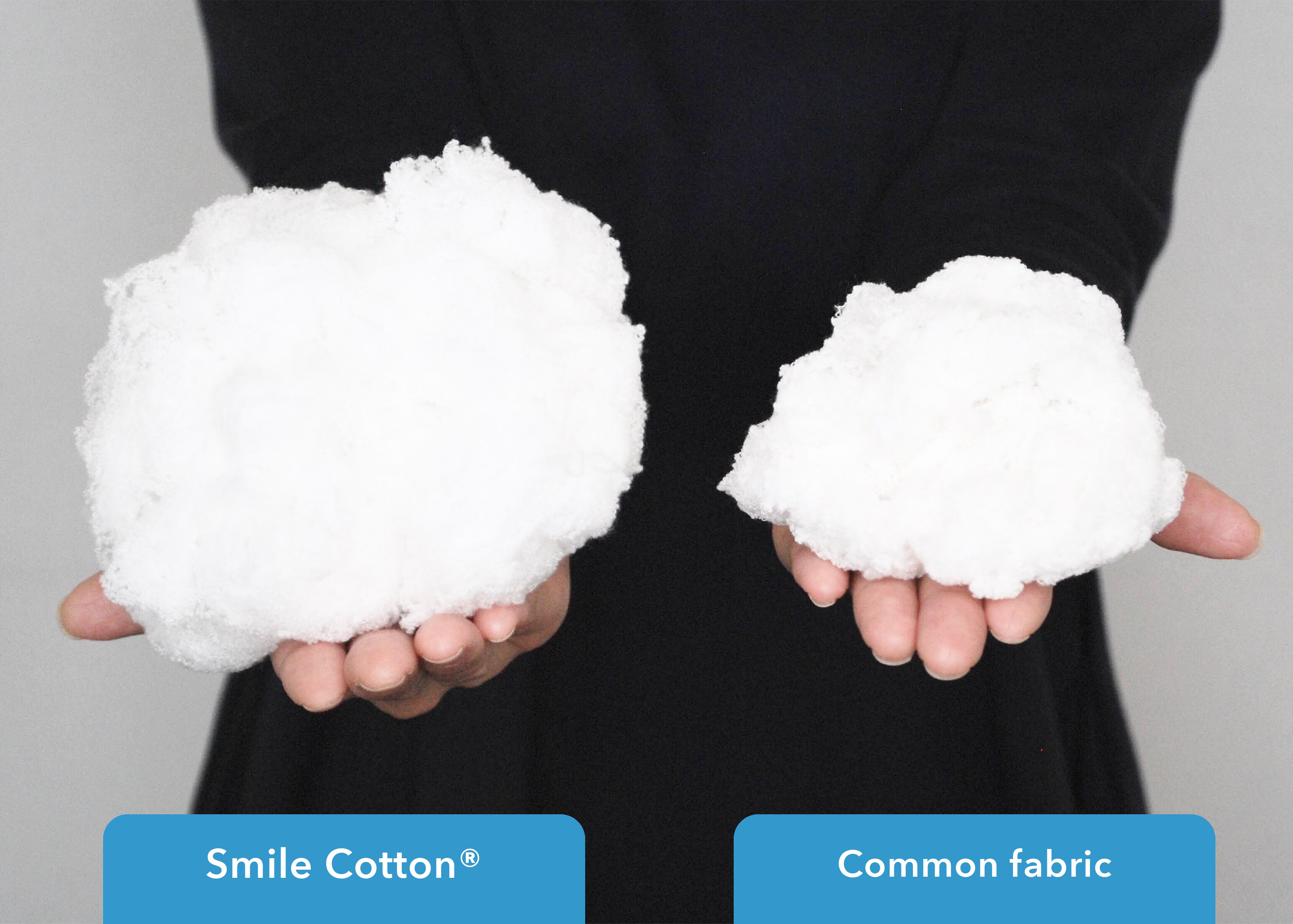
Can you see the obvious difference between these two pieces of cotton on the left and right, even though they both weigh 10 grams? The secret lies in the “twist of the yarn.” For example, there’s a huge difference in softness between a tightly wrung-out piece of fabric and a loose, fluffy one, isn’t there? Smile Cotton® achieves this right at the “yarn stage.” In other words, we deliberately loosen the twist of the fibers, leaving them somewhat untwisted. This gives it a texture closer to “cotton batting” than to yarn.

Because it contains plenty of air between the fibers, it is fluffier than ordinary fabrics and has a natural loft. This fundamental difference in the material used for the yarn itself is what makes Fleep unique. When I actually touched it, it felt strangely soft against my skin—almost like a cross between cotton and silk.
It’s gentle on the skin, but a challenging material for craftspeople. That’s right... it’s difficult to sew.
Can you imagine how different it is to sew crisp fabric on a sewing machine compared to sewing a material as soft as cotton? Furthermore, Fleep is underwear with a three-dimensional structure designed to fit the body. Even with the desire to provide users with the most comfortable fit possible, the sewing process requires advanced technical skills. Sewing machine maintenance must be handled with great care, and the time required for sewing can sometimes be more than double that of standard garments.
Even so, Mr. Shimazaki remains adamant.
Seams should face outward, and the parts that touch the skin should be flat.
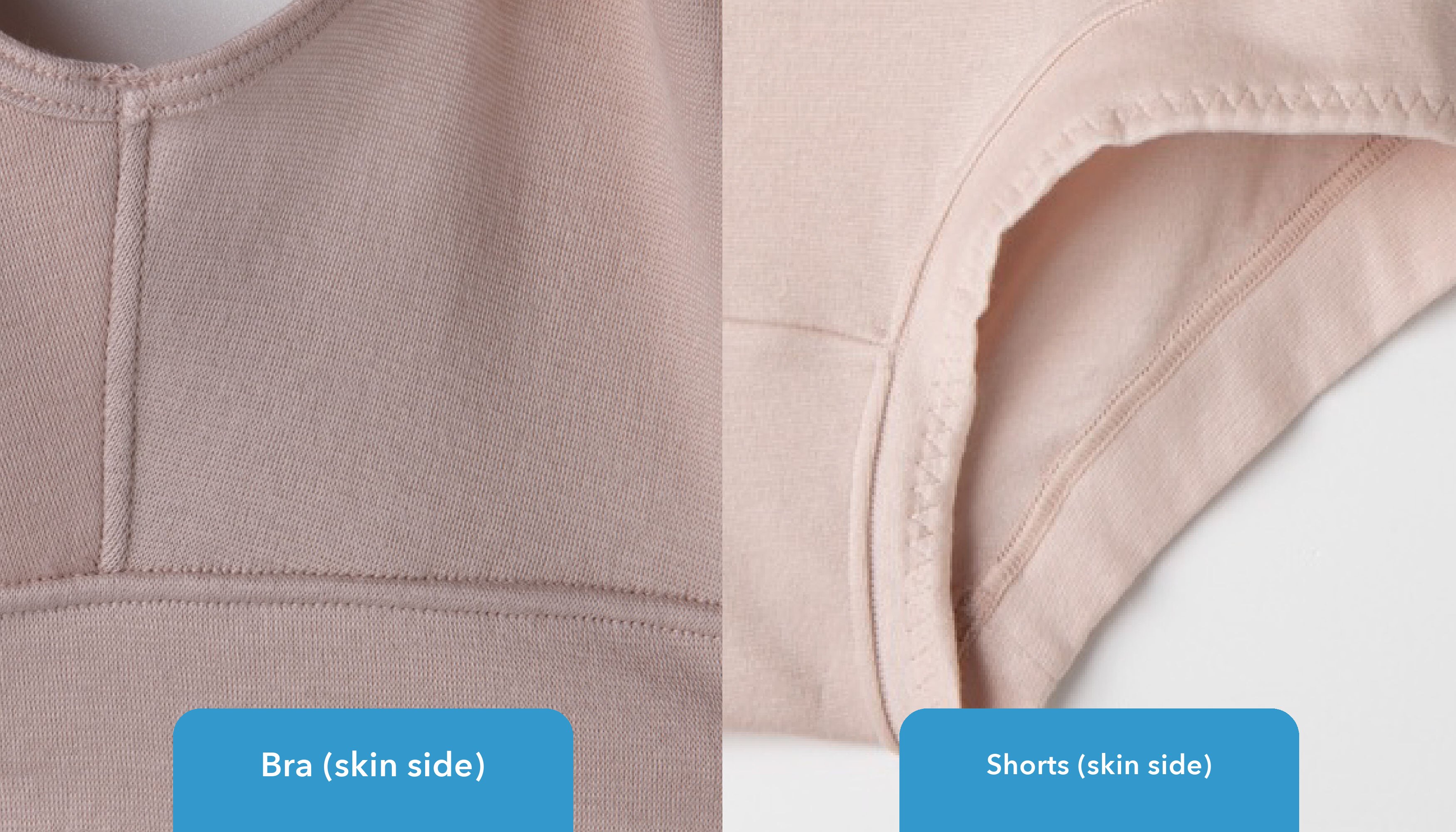
Even though this fabric is already difficult to sew, Fleep features special specifications designed with the user in mind—down to the very last detail. Believe it or not, the seams run in the opposite direction from what’s usual. The textured seams are positioned on the outside so they don’t touch the skin, while the inner side that comes into contact with the skin is designed to be as flat and gentle as possible.
The tag is on the outside so it doesn't touch the skin, and it can be removed
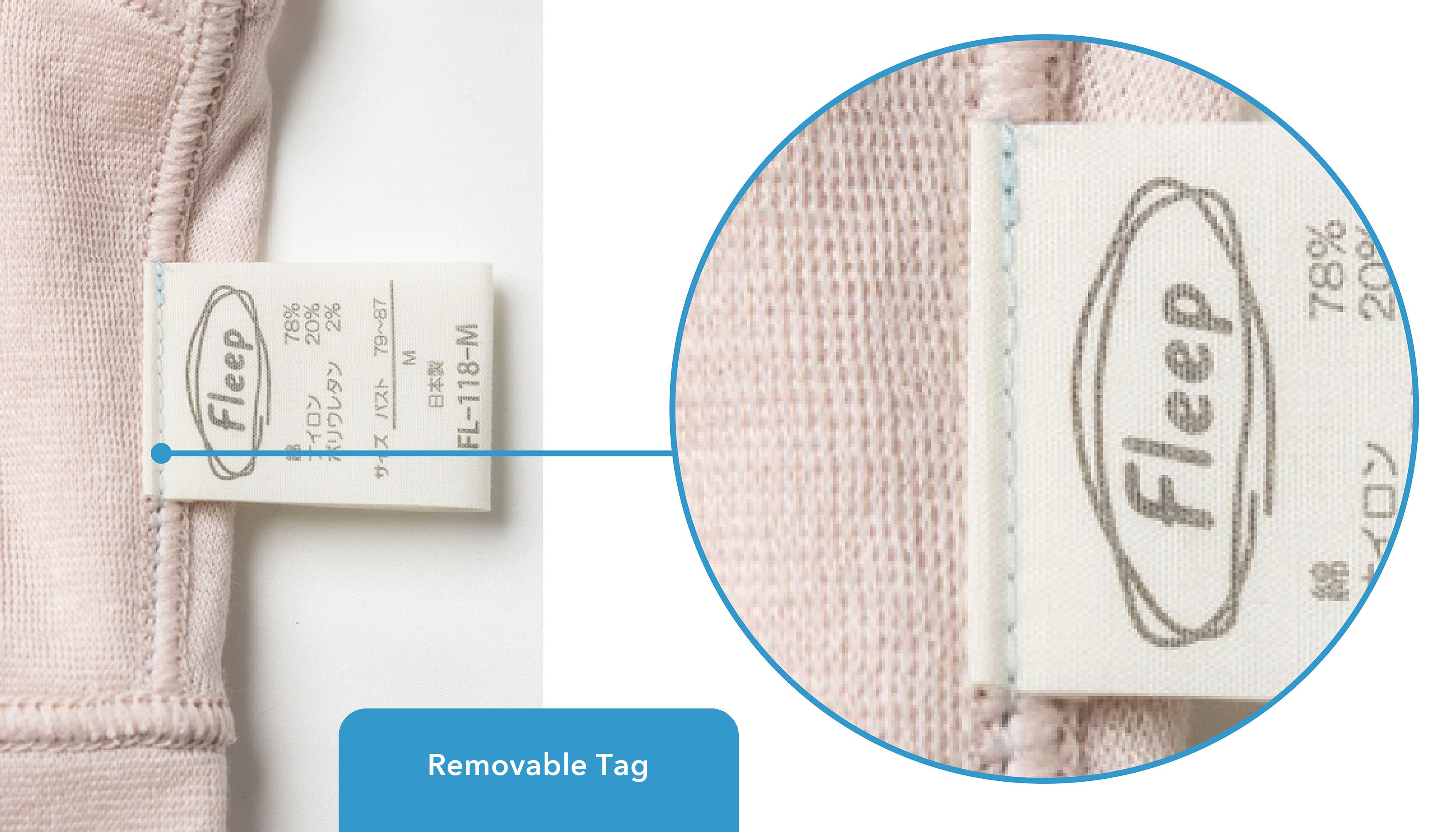
We pay meticulous attention to detail even in our tags. Typically, tags that display information such as quality specifications and sizes can feel uncomfortable to the wearer and are a source of irritation when they come into contact with the skin. At Fleep, we’ve designed the tags to be sewn onto the outside of the garment in advance, ensuring they don’t come into direct contact with the skin. Furthermore, the tags are attached with distinctive blue thread so they can be easily removed.
Thinking About People on the Move
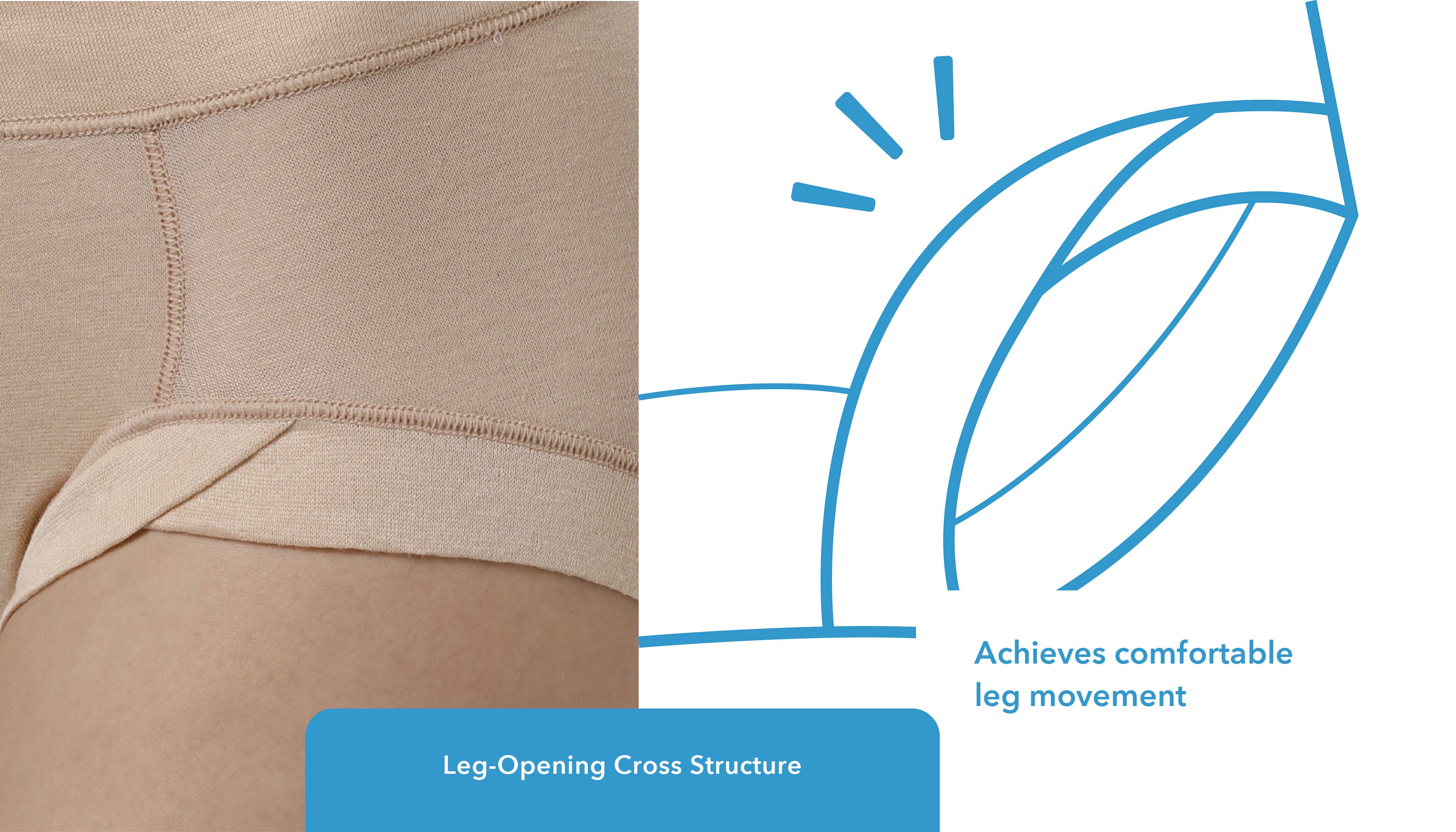
In addition to our commitment to achieving the perfect feel against the skin, Fleep is also known for its meticulous attention to detail in tailoring that adapts to the body’s movements. For example, some items feature a cross-stitched construction in the leg openings to smoothly support leg movement. These thoughtful details are carefully incorporated into every Fleep product.
Think about the patients who are hospitalized as well

This is a front-opening undergarment that has been well-received by hospitalized patients. Designed to be easy to put on and take off, it combines the functionality of a front-opening style with the soft, comfortable feel of Smile Cotton®, making it ideal for wear after breast cancer surgery. It is a garment filled with kindness and thoughtfulness—one that healthcare professionals will want to recommend to their patients.
So, how did such an appealing product come to be? In this article, we spoke with Mr. Shimazaki, the CEO of Shimazaki Co., Ltd., and Ms. Yamamoto to learn about their vision and their commitment to craftsmanship.
We spoke with Ms. Yamamoto, the sales department manager—who knows everything about our products better than even the president—to learn about our products and hear some behind-the-scenes stories about their development.

Thank you for taking the time to meet with me today despite your busy schedule. In an era where underwear is readily available—with Uniqlo leading the way—I find it fascinating that the Fleep brand concept has not only gained support from the general public but has also expanded beyond that into the medical field. I’d love to hear more about that and other related topics.
Q: What led to Q Fleep gaining support in the healthcare industry?
Why Underwear for Sensitive Skin Naturally Gained Traction in the Medical Field: The Truth Is, We Hadn’t Realized There Was Such Potential Demand at All....
Fleep is a brand that originally started with the goal of creating “underwear that anyone can wear with confidence,” specifically for people with sensitive skin. At first, we weren’t thinking about the medical field, and we never imagined it would catch on in hospitals.
The turning point came when I received a sudden phone call from a university hospital. A breast cancer counselor at that hospital had happened to see Fleep products at the Isetan department store in Osaka and thought, “Wouldn’t this be good for breast cancer patients?” That led to me being given the opportunity to explain the product in detail.
At the time, we were marketing “front-opening bras” designed primarily for breastfeeding, but the structure of the padding and the fabric’s gentle feel against the skin were recognized as suitable for breast cancer patients as well. Although this was an unexpected discovery, it gradually led to the product being adopted in medical settings.
After that, thanks to word of mouth and referrals from patients and healthcare professionals, it naturally began to be used in hospitals and other medical facilities.
What really stuck with me were the comments from a customer who had gone through breast cancer. She had been a loyal Fleep user even before her surgery, and I was deeply moved when she said, “I knew I could keep using it even after I got sick, so I didn’t feel anxious.” I think being able to continue using something you already use every day—rather than having to search for a special product after falling ill—provides a great sense of reassurance.
We’ve also received reviews on e-commerce sites and elsewhere saying things like, “I’ve been using this after breast cancer surgery,” and we ourselves have often come to realize this demand only after the fact.
Furthermore, on a website dedicated to cancer patients, Fleep was praised for the comfortable fit of its armholes even while wearing a postoperative drain (a tube used to drain bodily fluids), and this aspect also drew attention.
Our goal in creating these products is not so much to make them for medical use as it is to ensure that “anyone can wear them comfortably.” Therefore, our ideal is for people to use them naturally in their daily lives, without being constrained by the idea that they are for medical purposes.
Of course, I fully acknowledge the fact that our products are used by patients, but I still strongly believe that people should enjoy them as fashion items. That’s precisely why I never compromise on design or color, and I always make sure to convey that to our designers.
Recently, we’ve seen an increase in customers across all genders and age groups. While our products were originally geared primarily toward women, we’ve begun to focus more on men’s items as well, and following a feature in “President Online,” we’ve seen a rise in orders from men in their 50s and 60s. In addition, our products are used by children with sensitive skin and the elderly, and we feel that our brand image as “underwear that anyone can wear with confidence” is gradually gaining recognition.
Q: Please tell us about the materials and stitching that even skilled craftsmen found challenging to work with, despite the resulting soft, comfortable feel.
"I don't want to sew anything this difficult anymore." Underwear that drove the production team to tears ended up creating a sense of comfort.
Fleep uses an exceptionally soft fabric called “Smile Cotton®,” which prioritizes comfort against the skin above all else. While this fabric provides the wearer with incredible comfort, it has posed unprecedented challenges for the sewing workshop. In fact, even seasoned seamstresses with many years of experience at the factory have cried out, “I’ve never sewn a fabric this difficult before.” For the first two to three years after the brand’s launch, everyone said they “didn’t want to sew it” or “couldn’t keep doing it,” and at one point, there were even serious concerns from the production floor about whether the brand could continue.
The reason I was able to keep going without giving up was that, through daily trial and error, I gradually built up a body of knowledge about “sewing techniques” and “how to work with fabrics.” I honed my skills with company-wide support that transcended departmental boundaries—from machine maintenance staff to fabric buyers.
In addition, feedback from our customers—especially words of gratitude from those with sensitive skin and breast cancer patients—has been a source of motivation for our team on the front lines. Today, many of our sewing staff say, “Sewing Fleep is the most rewarding part of my job,” and the initial challenges have gradually transformed into a source of pride for the brand.
Since a stable supply of the raw materials themselves cannot always be guaranteed—and variations in color and fiber texture can occur—we continue to manufacture our products while working closely with fabric manufacturers to ensure consistent quality. In short, this is a brand that demands “meticulous attention to detail” at every stage—from material production to sales—not just in the sewing process.
All Fleep products are manufactured in our own factories and partner factories in Japan, and they are backed by a level of design and quality that could not be achieved through overseas production focused on efficiency. As a result, our products are by no means inexpensive, but we hope you’ll understand that they are the result of a great deal of effort, technical expertise, and passion.
Q From the perspective of wholesale and retail, please share the strategies and insights that have emerged from your company’s experience to date regarding the use of customer feedback, the balance of sales approaches, and challenges in digital advertising.
Rather than spending money on the internet, a more traditional approach is actually more effective. Conversations with customers shape the future of the brand.
We value every point of contact with our customers. Whether it’s a casual comment made during a phone order, feedback from paper or online surveys, or reviews posted on our e-commerce site, we record and analyze all the authentic feedback we receive daily and use it to inform our product development. We have accumulated over 700 surveys annually, which include detailed suggestions for improvement, such as “It’s difficult to insert or remove the pads.” Especially when taking orders over the phone, we are able to hear about customers’ concerns and worries through casual conversation, and we record these details as “customer notes.” We later use these as reference materials for product improvements and service planning. We believe that this “raw feedback”—which cannot be obtained by simply pursuing efficiency—is a vital clue that enhances the reliability and comfort of our products.
When it comes to sales strategies, we make a point of leveraging the strengths of traditional methods rather than relying solely on digital channels. It’s true that e-commerce accounts for a large portion of our total sales volume, and we do implement measures such as digital advertising. However, the reality is that due to factors like soaring advertising costs, we’re finding it harder to achieve the same level of effectiveness as before. Furthermore, since some customers aren’t accustomed to placing orders online or give up as soon as they reach the login screen, it’s not realistic to consolidate everything online.
In that regard, there are still many customers who browse our paper catalogs and place orders by phone, and the sense of security and trust that develops through conversation often leads to repeat business and word-of-mouth recommendations. In fact, some of the phone orders we receive develop into consultations or casual conversations that go beyond the order itself, and we sometimes gain insights for product improvements from these interactions. We also place great importance on face-to-face interactions at events and trade shows, and we feel that being able to “see the faces” behind the brand helps build trust.
We also carefully record and manage the information we gather through analog channels within the company, and I believe that this accumulated data ultimately serves as the foundation for responding to the diverse feedback we receive from our customers. Rather than settling on a single approach, we intend to continue being as flexible and resourceful as possible moving forward.
Q: In an era where direct sales are possible, what do you think are the reasons for choosing to collaborate with wholesalers?
Do We No Longer Need Wholesalers? — Why We, Who Once Thought That, Now Rely on Them
For small and medium-sized businesses like ours, we’re truly grateful when wholesalers agree to carry our products. While we do have a direct-to-consumer sales system in place, there are limits to what we can do when it comes to manpower and logistics.
It’s a huge help that having a wholesaler act as an intermediary makes the coordination process run so smoothly. In particular, the fact that they handle not only deliveries but also “returns” when problems arise is something we, as a small-to-medium-sized business, truly appreciate. Including their support with credit terms, I feel we have a system in place that allows us to conduct business with peace of mind.
In addition, I’m truly grateful that, through the wholesaler’s network, we’re able to connect with customers and sales channels that we would otherwise have a hard time reaching on our own.
In terms of logistics as well—for example, when selling to hospitals—there are cases where we can’t make deliveries without going through specialized wholesalers. In many cases, these wholesalers place bulk orders for us, which is much more efficient than shipping individually and is a huge help. The difference in the burden—both in terms of shipping costs and the amount of work involved—is night and day.
Especially in regions like Japan, where there are many small and medium-sized businesses and retail stores, I think having an intermediary—such as a wholesaler—step in really helps make transactions run much more smoothly. Even in the medical field, we need an intermediary to deliver goods to hospital gift shops, and that’s another area where I really appreciate the role that wholesalers play.
They continue to support me in all sorts of situations, and I truly find them a source of great reassurance.
Thank you very much, Ms. Yamamoto. I was surprised to learn that by simply continuing to create high-quality products, they eventually found their way into the medical field—something I hadn’t anticipated. I was also deeply impressed by your determination to keep taking on the challenge of working with difficult materials—the kind that most people would likely give up on, deeming them “inefficient.” Furthermore, your story about how—even in this age of digital dominance—you gain numerous insights and ideas for improvement from seemingly inefficient touchpoints, such as handling phone calls, really stuck with me. I believe that precisely because digitalization is advancing and face-to-face interactions are dwindling, the value of such interactions stands out even more. Furthermore, when considering not just sales but also post-sale support—including product recalls in the event of issues—I can truly appreciate the significance of having a wholesaler act as an intermediary. The role of the wholesaler shines not only during the sale but especially afterward—this perspective was also a valuable lesson for me.
Ms. Yamamoto shared with us the challenges she faces on the front lines and the difficulties she encounters in keeping the business going. With those sentiments in mind, our editorial team would like to take this opportunity to pose some candid questions to the president.
"President! Why are you taking on such a difficult challenge?"
We spoke with Hiroyuki Shimazaki, President and CEO of Shimazaki Co., Ltd. We explore his motivation for why and how he has continued to develop Fleep, a product that reportedly emerged in response to feedback from the field stating, “We don’t want to sew anymore.”

Q Why have you continued to make products that are so difficult that people say, “I don’t want to sew them”?
Fleep, Which Took Advantage of the Off-Season to Launch
The reason we launched Fleep was to address the problem of “slow seasons,” which are unavoidable when you own your own factory. “We have 60 employees—what are we going to do next month?”..... Demand fluctuates with the seasons—spring, summer, fall, and winter—so while there’s plenty of work during busy periods, there’s almost none during slow periods. External orders tend to have low unit prices, and the resulting losses and reduced production capacity affect employee salaries. That’s why we needed to establish a brand that would allow us to control production ourselves and keep the factory running year-round.
It was around that time that we discovered a special fabric called Smile Cotton®. Soft and comfortable, this fabric was a perfect fit for our history of “gentle craftsmanship,” a tradition passed down from my grandfather’s and mother’s generations. On the other hand, it was extremely difficult to sew, and we received many comments from the production floor saying it was “hard to work with.” I even recall a representative from a major manufacturer once telling us, “There’s no way we’d ever work with a fabric this difficult.” But I remember my mother (who was the president at the time) and I looking at each other and saying, “That’s exactly why it’s a good fit for us.” We felt that precisely because no one else was doing it, it would set us apart and reinforce our company’s raison d’être.
Q: How has your continued development of challenging products like Fleep benefited your production teams and your brand?
The Knowledge That Engineers Acquire Through Hands-On Experience
By continuing to produce labor-intensive products like Fleep, our technicians become familiar with the materials and processes, accumulating know-how that other companies cannot replicate. As we continue sewing for six months or a year, our skills become more refined, and the entire factory’s responsiveness improves. This is a major asset for the brand—one that cannot be measured by short-term efficiency alone.
As our engineers gained experience, we were able to improve efficiency by setting up a dedicated production line for Fleep. It is precisely because the material is so challenging that we are able to create products that other companies cannot replicate; today, this very “challenge” has become the source of our brand’s differentiation and our technical assets.
At Shimazaki, we frequently work with fabrics that are difficult to sew, and we have experience handling thin, soft, and stretchy fabrics. As a result, we have established a system that allows us to naturally accommodate the production of Fleep across all our product lines.
Q Please tell us about the significance of having our own factories in Japan, and how you plan to coordinate with overseas factories amid rising prices.
A burden, and at the same time, our greatest weapon
While owning our own factory places a heavy burden on us in terms of labor and fixed costs, it also gives us a major advantage: the ability to manufacture complex products that other companies cannot produce. I used to believe that a fabless business model, relying on external contractors, was more flexible and preferable. However, when our factory in Iwate was damaged in the Great East Japan Earthquake yet remained standing—providing an environment where our employees could continue to work—my mindset shifted to one of “We must protect this.”
Volume, Price, and the Significance of Owning Our Own Factory
To keep a factory running, we need to produce enough volume to fill its capacity. For that reason, we set our prices with the expectation of selling a certain volume. Even if niche products are well-received, we cannot keep the entire factory running without sufficient volume. While we sometimes operate at a loss, it is precisely because we own our own factory that we can continue to take on new challenges while absorbing those losses across the entire group. I believe this is the greatest benefit of owning our own factory and a strength that no other company possesses.
The Weaknesses of Everyday Clothing and the Challenges of Domestic Production
Furthermore, because underwear is considered “practical clothing,” it is difficult to raise prices. Unlike luxury brands, it is hard to significantly increase prices to secure profits, and as a daily necessity, consumers are very price-sensitive. While the national minimum wage rises every year, it is difficult to pass these costs on to retail prices, creating a structural challenge. Although we used to place a strong emphasis on “Made in Japan,” it has become difficult to continue production solely within Japan under these circumstances. While Japanese factories excel in quality and responsiveness, we have no choice but to incorporate overseas production for items where domestic pricing is not viable. We are currently conducting trial production of some of our standard products in Vietnam and exploring ways to blend domestic and overseas production systems.
Q: As Fleep and as Shimazaki, what kind of developments and future do you envision moving forward?
We want to raise awareness and reach those who need it.
Fleep has been around for 18 years, but it’s still a relatively unknown brand. Recently,President MagazineThanks in part to the media coverage, more and more customers are discovering our products for the first time and saying, “I didn’t know underwear like this existed.” Our top priority right now is to raise awareness so that our products reach as many people in need as possible.
There are people not only in Japan but also overseas who have sensitive skin or are struggling to find suitable underwear after breast cancer surgery. I’ve heard there is a similar need in Taiwan and South Korea, and there have even been instances where people from China went out of their way to come to our company to make a purchase after seeing our products featured by Chinese influencers on social media. These trends have made me strongly feel that there is great potential for our business to expand overseas.
Expanding Possibilities Through Collaboration with Wholesalers
That said, small companies like ours face limitations when it comes to PR and developing sales channels on our own. That’s precisely why I believe it’s important to work together with wholesalers. Wholesalers have extensive networks and customer touchpoints, and they can play a key role in reaching specialty stores in rural areas and expanding overseas. For example, by collaborating with wholesalers, we can expand the possibilities for events like PR gatherings that bring together customers from specialty stores. We believe that growing our business by collaborating not only with our own company but with the entire distribution network will pave the way for Fleep’s future.
While cost and environmental changes both domestically and internationally are challenging, the experience and expertise we’ve gained by continuously taking on the challenge of working with difficult materials are our greatest assets. Our goal is to preserve these assets while continuing to deliver “underwear that people choose” to those in need. I believe this is the future of Fleep—and of Shimazaki.
Thank you, President Shimazaki.
What struck me most from our conversation was that the Fleep brand is, in itself, a history of accumulating “value that cannot be measured by efficiency.” By continuously taking on the challenge of working with difficult-to-sew materials, the technicians have accumulated a wealth of know-how that has become an asset no other company can replicate. Furthermore, despite shouldering the heavy burden of maintaining their own factory, their determination to turn that burden into a strength and use it to build a future for the company conveyed a strong sense of pride in their craftsmanship as a manufacturing enterprise. At the same time, I was impressed by how they continue to grapple with practical challenges—such as rising prices and increases in the minimum wage—while exploring partnerships with overseas factories and wholesalers, all the while constantly considering how to ensure their products reliably reach “those who need them.” The phrase “turning challenges into strengths” may sound simple, but Fleep’s journey—having sustained this approach for 18 years and transformed it into brand differentiation and trust—is surely a beacon of hope for the apparel industry. How will the brand expand both domestically and internationally in the future? Fleep’s journey of innovation continues.
/ Tag
LISTEN Back to Top