
Learn About the Participating Companies
LISTEN

“The Future Lies on the Front Lines”—What Is the “Logistics That Identifies Challenges” Practiced by Shunwa Logistics, Now in Its 50th Year?
Interview with Ken Gyotoku, Director of Shunwa Logistics Co., Ltd.
For over 50 years since its founding, Shunwa Logistics has evolved from its origins as a delivery agent for department stores to a company that now offers a wide range of logistics services—including transportation, delivery agency services, and e-commerce logistics—while developing 3PL (third-party logistics) as a new pillar of its business.。
In addition to our one-stop service covering warehouse storage, inventory management, distribution processing, shipping and delivery, order fulfillment, and e-commerce logistics, we have supported logistics challenges across a wide range of industries by leveraging our strength in flexible logistics design enabled by our in-house WMS (Warehouse Management System). Another unique feature of Shunwa Logistics is our ability to propose the optimal logistics solutions for each client by leveraging our 21 locations nationwide and four logistics hubs.
However, what struck me most about this interview was not the breadth of their logistics services. What came up repeatedly during our conversation was their approach of “starting with the customer’s challenges.”
Logistics is not visible on the surface of business operations. However, precisely because we know the inner workings better than anyone else, we can identify challenges that others cannot and find solutions that others cannot.
Before we begin the interview, let me introduce a few of Shunwa Logistics’ unique initiatives.
Main Areas Served by Shunwa Logistics
We go beyond simply “transporting” goods; we provide integrated, optimized solutions that encompass warehousing, logistics planning, transportation, and delivery to solve each customer’s unique logistics challenges. Rather than offering each service separately, we design a comprehensive logistics strategy that supports improved operational efficiency, cost reduction, and enhanced brand value. This is the logistics solution envisioned by Shunwa Logistics.
Shunwa Logistics' New Initiatives
Kimijiro: Shipping Agency Service for Small Businesses

In recent years, as the e-commerce market has expanded, small brands and startups have had increasing opportunities to sell their products online. However, because of their limited product ranges and low shipment volumes, it is often difficult for major logistics companies to accommodate them, and in many cases, logistics costs and operational burdens have become obstacles to business growth.
Shunwa Logistics’ e-commerce fulfillment service, “Kimilogi,” was created to address these challenges.
Kimiroji is,"A shipping agency service you can use starting with just one shipment a day"Based on this concept, we offer a logistics service that even small businesses and startups can use with confidence. In addition to product storage, inventory management, and shipping operations, our in-house WMS (Warehouse Management System) enables centralized online management of everything from inventory checks to shipping instructions. Leveraging our expertise in packaging and transporting cosmetics, we build flexible logistics systems tailored to each client’s business, including gift wrapping, bundling promotional materials, and handling returns.
We support the growth of not only large corporations but also small brands through logistics. Kimilogi is a service born from our desire to bring the department-store-level quality and logistics expertise that Shunwa Logistics has cultivated over many years to brands that are poised for growth.
Hanger Transport (Hanger Cart)
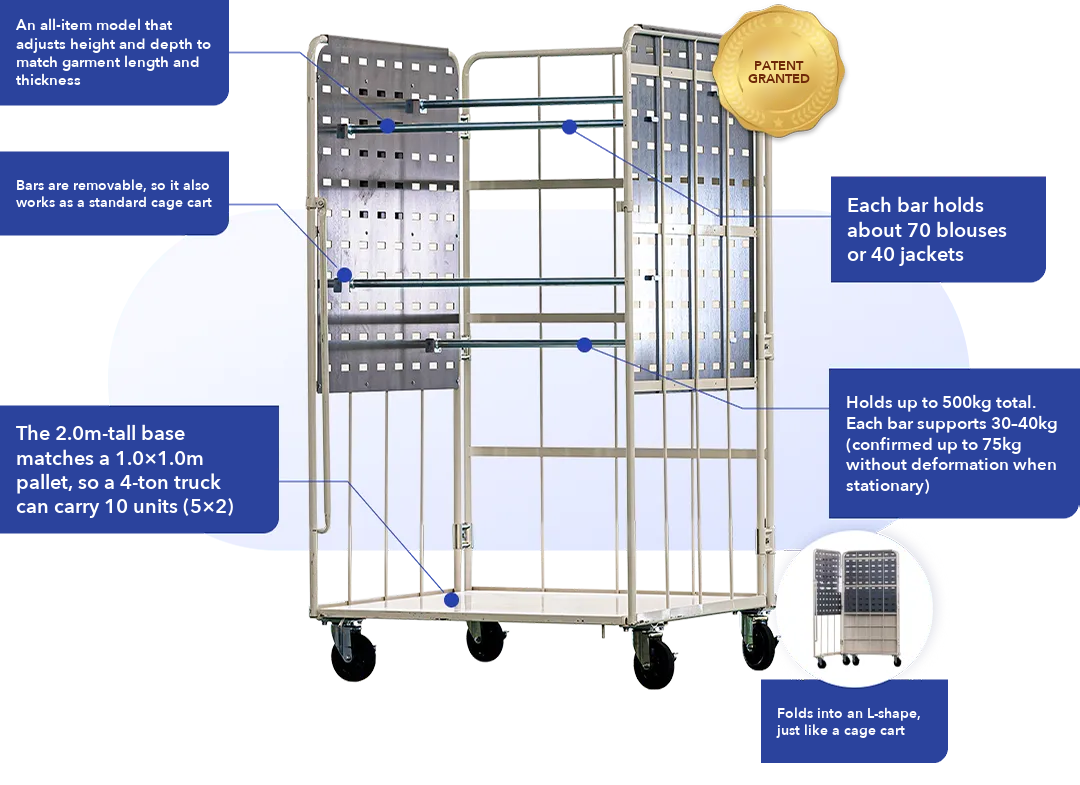
In recent years, due to a decline in heavy apparel shipments and changes in the logistics structure, the number of logistics companies capable of handling hanger transport has been decreasing year by year. Despite this trend, Shunwa Logistics views hanger transport as a critical component of logistics infrastructure and has developed a patented hanger cart. The company is committed to creating new systems that balance quality and efficiency in apparel logistics.
When you look at Shunwa Logistics’ services—such as hanger transport and Kimijiro—one common thread becomes apparent.
It’s the idea of “creating services to solve problems” rather than simply “selling services.”
So, how did that way of thinking come about, and how has it been passed down through the generations?
From here on, Director of Shunwa LogisticsKen GyotokuWe’ll be talking with him about the origins and future of this project.

Q: You started your career in the field of department store delivery services—a line of work that demands particularly high standards of quality and precision. What experiences laid the foundation for the unique character of Shunwa Logistics today?
The Origins of Shunwa Logistics: Nurtured by Department Store-Level Quality
Shunwa Logistics began as a company that handled deliveries on behalf of department stores.
At that time, the standard procedure was for a manufacturer’s sales representative to bring the merchandise to the department store’s distribution center, conduct an inspection in the presence of a department store representative, and then deliver the goods directly. Sales representatives are supposed to focus on interacting with customers and developing new products and sales channels. However, this was also a time when a significant amount of their time was spent on delivery and inspection tasks.
It was against this backdrop that the concept of “delivery agency” was born.
"We'll handle the deliveries for you. That way, you manufacturers can spend your time on the work you're actually supposed to be doing." This idea was the starting point for our delivery agency service.
The first department store to adopt our delivery agency service was one in Fukuoka. At the time, this was an unprecedented initiative in Kyushu, but through information sharing among department stores, the reputation that “you can trust Shunwa Logistics” spread, and the service eventually expanded to department stores throughout Kyushu. The trust we have built up since our founding is the foundation behind our continued success in handling numerous department store delivery agency services in Kyushu today.
Of course, department store logistics is by no means an easy job. There are strict standards for every aspect of the process—from delivery times and inspection to inventory management. Consistently delivering the required quality builds trust with our customers. The philosophy of “delivering quality that exceeds customer expectations,” cultivated in that environment, continues to be passed down through the generations at Shunwa Logistics today.
Since our founding, our work has not been limited to simply “transporting goods.” We have focused on creating an environment where our customers can concentrate on the work they are truly meant to do. To that end, we have provided value through our logistics services.
Looking back, I believe that this founding philosophy is the very foundation of Shunwa Logistics—one that has led to our current 3PL services (logistics services that comprehensively handle warehousing, inventory management, and delivery), e-commerce logistics, and our ability to solve challenges specific to each customer.
Q: You’ve taken on various challenges over the years. What do you consider to be the most significant turning point—the one that you feel “shaped Shunwa Logistics as it is today”? What were your thoughts when you made that decision?
A Second Founding: From a Logistics Company to a Logistics Solutions Provider
I think the biggest turning point for the company was when the current president took over.
Since its founding, Shunwa Logistics has focused its business primarily on providing delivery services to department stores. The previous president grew the company by centering its operations on “logistics that keeps vehicles moving” and built strong relationships of trust with department stores. At the same time, however, as times changed, the department store market became increasingly challenging, and there was a growing sense of crisis that “the company has no future if we simply continue with the same business as it is.”
Amid all this, the current president, who took over the company, had a strong interest in WMS (warehouse management systems) and believed that “logistics isn’t just about transportation—it’s about designing the system itself.”
Consequently, we expanded our warehouse operations—which had previously been conducted on a limited scale—into a full-fledged business. While developing our own WMS, we also began focusing our efforts on a new business venture: 3PL (a logistics service that comprehensively handles logistics operations such as product storage, inventory management, and delivery). While cherishing the strengths we had cultivated in department store logistics and transportation, we expanded our business into areas that support our customers’ entire logistics operations. That major shift in direction has become the foundation of today’s Shunwa Logistics.
Of course, this new challenge wasn’t all smooth sailing. Given the significant shift in the company’s direction, there were a variety of reactions both inside and outside the company. Nevertheless, the current president persistently worked on system development and on-site improvements, bringing each initiative to fruition one by one. These efforts gradually yielded results and grew into the pillars of the company’s current business.
Looking back, it could be said that this period was not merely a time of business expansion, but rather a “second founding” during which we reexamined the very reason for our company’s existence. While carefully preserving the high standards of quality we had cultivated through department store logistics and transportation, we also embarked on the 3PL business as a new pillar of our operations, striving to become a partner that supports our customers’ entire logistics operations. That journey continues to this day.
Q: It’s not uncommon for people to think, “Logistics companies just pick up and deliver packages, so it doesn’t matter which one you use.” In reality, what are the differences between logistics companies?

"Not all logistics companies are the same"
I think the biggest difference lies in the concept of “who the logistics are designed to serve.”
At many logistics companies, customers are often expected to adapt to the company’s systems in order to improve efficiency and productivity. This is because it makes operations easier to manage and facilitates standardization.
On the other hand, we take the opposite view.
Each brand has its own product characteristics, and packaging methods, delivery rules, and the brand experience customers want to convey all vary. That is precisely why, rather than asking customers to “adapt to Shunwa Logistics’ methods,” we base our approach on “tailoring logistics to each customer’s brand.”
Underpinning this approach is our in-house WMS (Warehouse Management System), which efficiently manages warehouse operations such as receiving, inventory, and shipping. The system incorporates not only product information but also detailed requests from each customer—such as “We’d like this brand to be packaged this way” or “We’d like this product to be delivered this way”—ensuring these can be accurately replicated on the warehouse floor. Rather than imposing our own views, we focus on how much of our customers’ feedback we can incorporate into our processes. The accumulation of these efforts has shaped the system we have today.
Of course, that makes things that much harder on the ground.
Since each client has its own operational methods, our logistics operations are as varied as the number of clients we serve—there are as many approaches as there are clients. If efficiency were our only concern, it would be much easier to standardize everything under a single set of rules. Nevertheless, we chose to adapt to our clients’ needs. As a latecomer to the industry, we felt that we had to offer that level of value to be chosen; above all, it was because of our company’s philosophy of “staying close to our clients.”
In fact, the very experience gained through this “Ten Companies, Ten Approaches” initiative has become a major asset for our company. As we accumulate a track record of working with various brands and industries, we’re able to make proposals such as, “In this particular case, we can implement this approach.” Tailoring our solutions to each individual client ultimately enhances the company’s overall ability to make proposals and respond to client needs.
Recently, we’ve seen an increase in customers switching to us from other logistics companies. The first thing these customers often say is, “Your email responses are surprisingly quick.” We aren’t doing anything special. We simply listen carefully to our customers’ feedback and respond thoughtfully to each and every message. I believe it is this consistent effort—something that might seem ordinary—that builds trust.
We don't aim to be just another logistics company that handles shipments.
We aim to be a logistics partner that understands the value of each brand and conveys its unique identity. That is what we believe sets us apart as a logistics company.
Q: I imagine you could have chosen to work exclusively with large corporations. Even so, why have you chosen to continue supporting small brands and clients that are still growing?

A New Logistics Revolution Called "Kimijiro": Growing Together with Small Brands
It all started for a very practical reason.
For a company of our size, it’s not easy to land large-scale projects from major corporations. Especially in the Kanto region, where competition is fierce, it’s difficult to be chosen among so many large logistics companies. So we decided to start by supporting small brands and businesses that are just getting off the ground.
That’s when we launched “Kimilogi,” a logistics service for small businesses.
Inspired by our president’s philosophy that “we hope to grow alongside our small customers,” we’ve established a system that allows customers to start with even small volumes. As the brand grows, the scale of its logistics operations will expand, and we hope they will continue to use Shunwa Logistics well into the future. This approach aligns the growth of our customers with the growth of our company.
Of course, this venture doesn’t generate significant profits right away. Still, we keep at it because this initiative has led to many new encounters and experiences.
We now receive inquiries almost every week, and the number of referrals has been increasing. In the past, even when we received referrals, we didn’t have a strong enough track record to fully demonstrate our capabilities; however, as the volume of logistics has increased at each of our locations, we are now able to confidently tell clients, “This is what we can do.” It’s not uncommon for connections made through Kimilogi to lead to new business opportunities.
In addition, Kimijiro offers the benefit of allowing brands to “start small.” They begin with a modest logistics operation and scale up their logistics infrastructure as their business grows. Being able to support them as they go through this journey is deeply rewarding for us as well.
Looking back, this initiative was not simply a “service for our younger customers.”
We work together to support brands as they develop and use our logistics services to fuel their growth. We, too, gain experience and grow alongside our customers. I believe it is this cumulative process that defines what makes Shunwa Logistics unique.
Q: From the perspective of a logistics company, are there any differences between “companies that are growing” and “companies that are struggling to grow”?
The state of logistics determines a company's future.
Having been involved in logistics for a wide range of clients for many years, I’ve come to realize that,How important does the company consider logistics to be?However, this is what has a major impact on the company's growth.
In the past, it was generally believed that logistics was a department that took a back seat to sales and planning. There was a strong perception that “logistics is just about moving goods,” and the department certainly did not have much influence within the company. However, today, more and more companies view logistics as a key component of their business strategy, and its importance is being recognized more than ever before.
The companies we’ve observed that are growing share certain common traits.
It’s the existence of an environment where the logistics department’s opinions are genuinely heard and where improvement proposals are incorporated into management decisions. Logistics staff can freely voice observations they make on the front lines, and management takes those concerns seriously. In companies like this, the atmosphere on the front lines is positive, responses are prompt, and customer service naturally improves. As a result, I’ve found that in many cases, the company as a whole experiences growth.
Conversely, in companies that view logistics solely as a “cost center,” improvement ideas identified on the front lines may not be fully utilized, leading to missed opportunities for improvement. Wouldn’t the accumulation of such missed opportunities eventually affect the company’s overall growth?
Logistics is not just about transporting goods.
This is where all kinds of company information—such as inventory movements, shipment volumes, and customer inquiries—converge. For example, is the volume of shipments increasing or decreasing? Are new products selling well? Are returns on the rise? The logistics team is the first to notice these changes. That is why we believe logistics is the department best positioned to quickly identify changes across the entire company.
We’re a logistics company, but we don’t just focus on packages.
Through our daily logistics operations, we take a holistic view of our customers' entire businesses.
That’s exactly why there are moments on the logistics front lines when I feel, “This company seems poised for growth” or “There’s room for improvement.”
Q: Shunwa Logistics has developed numerous systems and improvements—such as its proprietary hanger transport system and WMS—based on insights from the field. How do these ideas come about?

A Future Born from Our Customers’ Challenges
We don't just spend all our time in meetings trying to come up with new ideas.
In fact, we tell our employees, “Please gather information about the challenges our customers are facing.” Just by making a conscious effort to bring back that feedback—even once a week—you’ll start to see plenty of opportunities for improvement right on the front lines. I believe that new systems don’t so much emerge from within the company as they do from our dialogue with customers.
This philosophy is epitomized by our unique hanger transport system.
A customer in Kyushu approached us with the following concern: “Our shipment volume has decreased, and even though we’d like to continue shipping on hangers, the traditional method is no longer cost-effective.” Under normal circumstances, this might have been a conversation that ended with, “That’s going to be difficult.” However, we asked ourselves, “Isn’t there a way to make this work?” The result was a system that utilizes combination dollies to enable the transport of hanger-hung merchandise even in standard box trucks. Now, customers can ship hanger-hung goods in small lots without having to arrange chartered freight. The starting point for this innovation was not technology, but the customer’s problem.
We are developing the WMS based on the same approach.
Rather than asking our clients to adapt their operations to fit the system, we incorporate the specific requirements of each client’s brand into the system. While this does make day-to-day operations more complex, our ability to embrace that complexity is one of our greatest strengths. The feedback we gather on the ground is transformed into new systems, which in turn inform our proposals for future clients. It is this cumulative process that forms the unique expertise of Shunwa Logistics.
If you're only concerned with efficiency, it's easier to standardize.
Even so, we continue to listen to the diverse needs of our customers and strive to find ways to meet each and every one of them. It’s a difficult challenge, but we believe that this experience strengthens our company and helps us create new value.
What we value is not simply “trying to invent something new.”
To continue listening to our customers' concerns.
I believe it is precisely this accumulation of efforts that will give rise to new logistics and shape the company’s future.
Q: The logistics landscape is undergoing significant changes, driven by AI, automation, and other factors. Finally, is there anything you’d like to convey to companies as a logistics provider?

Logistics changes when you “talk it over.”
When people think of logistics, I believe many imagine “storing goods” or “arranging for delivery.”
However, we believe that would be a waste.
Logistics companies support the logistics operations of various businesses on a daily basis. As a result, they possess information and a network covering the entire logistics landscape—something that no single company could see on its own.
For example, “Which warehouses have available storage capacity?” “In which areas are there available delivery vehicles?” “How do logistics flows differ between peak and off-peak seasons?” Furthermore, there is information that only a logistics company can provide, such as logistics best practices and improvement examples developed across various industries.
By combining this information and experience, we can sometimes propose new solutions to challenges such as “Can we make our logistics more efficient?”, “Can we change how this product is stored?”, and “Can we review our shipping costs?”
That is precisely why we chose a logistics companyNot just a “company you hire for shipping,” but a “partner you consult with about logistics”We hope you will make use of it in this way.
There is still room for improvement in logistics.
We work together with our customers to address their challenges and develop optimal systems from a logistics perspective. Isn’t that the role expected of logistics companies in the future?
At Shunwa Logistics, we aim to expand the possibilities of logistics together with our customers as a partner supporting the growth of their businesses.
For this interview, we had originally planned to focus on the company’s 50-year history and the details of its logistics services. However, as the conversation progressed, our attention naturally shifted to Shunwa Logistics’ “problem-solving capabilities.”
We tackle the unique challenges faced by each client, design logistics systems from the ground up, and create new frameworks. This approach completely overturned our preconceived notions of what a “logistics company” should be. As a result, we spent more time than originally planned asking about their approach to addressing each individual challenge and the philosophy behind it, and the structure of this article naturally centers on those topics.
The Tokyo Knitwear Wholesalers Association introduces its member companies, which take on the challenge of manufacturing every day. Often, the true appeal of these companies only becomes apparent when you hear their stories firsthand. Once again, we learned a great deal ourselves through this interview.
We hope this article will serve as an opportunity to reflect not only on Shunwa Logistics’ initiatives, but also on the value of logistics as a profession that supports manufacturing, as well as the new possibilities that arise when manufacturers, wholesalers, and logistics providers work together.
/ Tag
LISTEN Back to Top