
The World of Knitting: The More You Learn, the More Interesting It Gets
KNITTERESTING
How to Build a “Happy Organization” Based on Data — An Interview with Kazuo Yano of “Trinity Organization”: Why the “Triangle” Strengthens People and Organizations
Interview with Kazuo Yano / Fellow, Hitachi, Ltd.; CEO, Happiness Planet, Inc.
Interview :
2026/5/18

- Chapter 1: Why Do Some Workplaces Within the Same Company Foster Happiness, While Others Lead to Burnout? The Organizational Turning Points Revealed by the Data
- Chapter 2: “V-Shaped” and “Triangular”: Common Characteristics of Happy Organizations Revealed by the Data
- Chapter 3: Why Is Modern Society Heading Toward a V-Shaped Trajectory? The Structure of Isolation Created by Social Media and Rationality
- Chapter 4: Can Organizations Resilient to Change Be Created? Why Triangles Bring Adaptability to Organizations
- Chapter 5: Is It People or Organizational Culture That Makes the Triangle?
- Chapter 6: Triangles That Transcend Organizational Boundaries Strengthen Industries
- Chapter 7: What Comes After Generative AI? The New Form of Intelligence Pioneered by Creative AI "Fira"
- Chapter 8: How AI Will Transform Companies—From Division of Labor to Autonomy: A Major Organizational Shift Begins
Why do some organizations thrive while others struggle, even though they operate in the same industry, offer similar products, and are made up of similar people? In the world of knitting, a single strand of yarn cannot form fabric on its own. It is only when strands of yarn interlock to form stitches that a supple yet strong fabric is created. It is a structure—flexible, strong, and adaptable to change—born from the “relationships” between the threads. This principle may, in fact, apply to organizations and industries as well.
When we talk about organizations, we tend to focus on individual abilities and leadership. In reality, however, people do not achieve results on their own. The nature of relationships between people has a significant impact on an organization’s vitality and creativity—and even on the well-being of its employees.
Kazuo Yano, CEO and Representative Director of Happiness Planet, Inc. and author of *The Trinity Organization*, has been conducting data-driven research on these “connections between people” for over 20 years.
While analyzing behavioral data totaling more than 10 trillion data points, Mr. Yano discovered that “happy and productive organizations” share a common structure. This is the “triangular relationship (Trinity)” discussed in this book.
In this interview, using the “Trinity Organization” as a starting point, we discussed why people become isolated, why organizations lose their vitality, and what new forms of organization are needed in the age of AI.
What are the conditions for a “happy organization” as revealed by the data? We’ll explore the power generated by human connections based on Mr. Yano’s insights.
Chapter 1: Why Do Some Workplaces Within the Same Company Foster Happiness, While Others Lead to Burnout? The Organizational Turning Points Revealed by the Data
Q. You have been researching human well-being and organizational productivity for many years. What initial concerns led you to begin this research?
For over 20 years, I have been researching human well-being and organizational productivity. My motivation was very simple: I wondered why there were such significant differences in results among organizations doing similar work. For example, even among call centers that use the same manuals, handle the same products, and operate in similar markets, one might perform exceptionally well while another does not. Or, simply changing a leader can drastically alter an organization’s atmosphere, sometimes even affecting performance six months later.
When we talk about an organization’s performance, we tend to focus on “people’s abilities.” However, in reality, people do not work in isolation. They are constantly interacting with others, being influenced by them, and collaborating as they work. That’s why I began to wonder if we shouldn’t focus not on “people themselves,” but on “the relationships between people.”
Actually, I specialize in theoretical physics. In physics, the properties of matter are determined not by the atoms themselves, but by the way they are bonded together. Even a slight change in the way they are bonded can turn a substance into a magnet, a metal, or a material with entirely different properties. Isn’t human society the same? If we think of people as individual atoms, isn’t it not just the abilities of individuals, but the way people connect with one another that determines the nature of an organization? That line of thinking was the starting point for this research.
So we developed our own wearable sensor. Human body movements reveal emotions and relationships that cannot be put into words. Furthermore, using that sensor, we simultaneously measured “who was interacting with whom” and “what kind of communication was taking place.” In other words, we collected not only individual data but also a massive amount of data on interpersonal relationships. Over the past 20 years, we have collected more than 10 trillion data points from various companies and organizations. While analyzing this vast amount of data, I have consistently pursued a single question: “Do happy, highly productive organizations share common characteristics?” For a long time, I referred to this as “Factor X.”
The industries, cultures, and companies are all different. Every organization has its own unique character. However, when we looked beyond those differences, we found that organizations with high levels of happiness, engagement, and productivity shared surprisingly similar characteristics. And that “X factor” turned out to be the “Trinity”—the triangular relationship—that this book explores.
Chapter 2: “V-Shaped” and “Triangular”: Common Characteristics of Happy Organizations Revealed by the Data
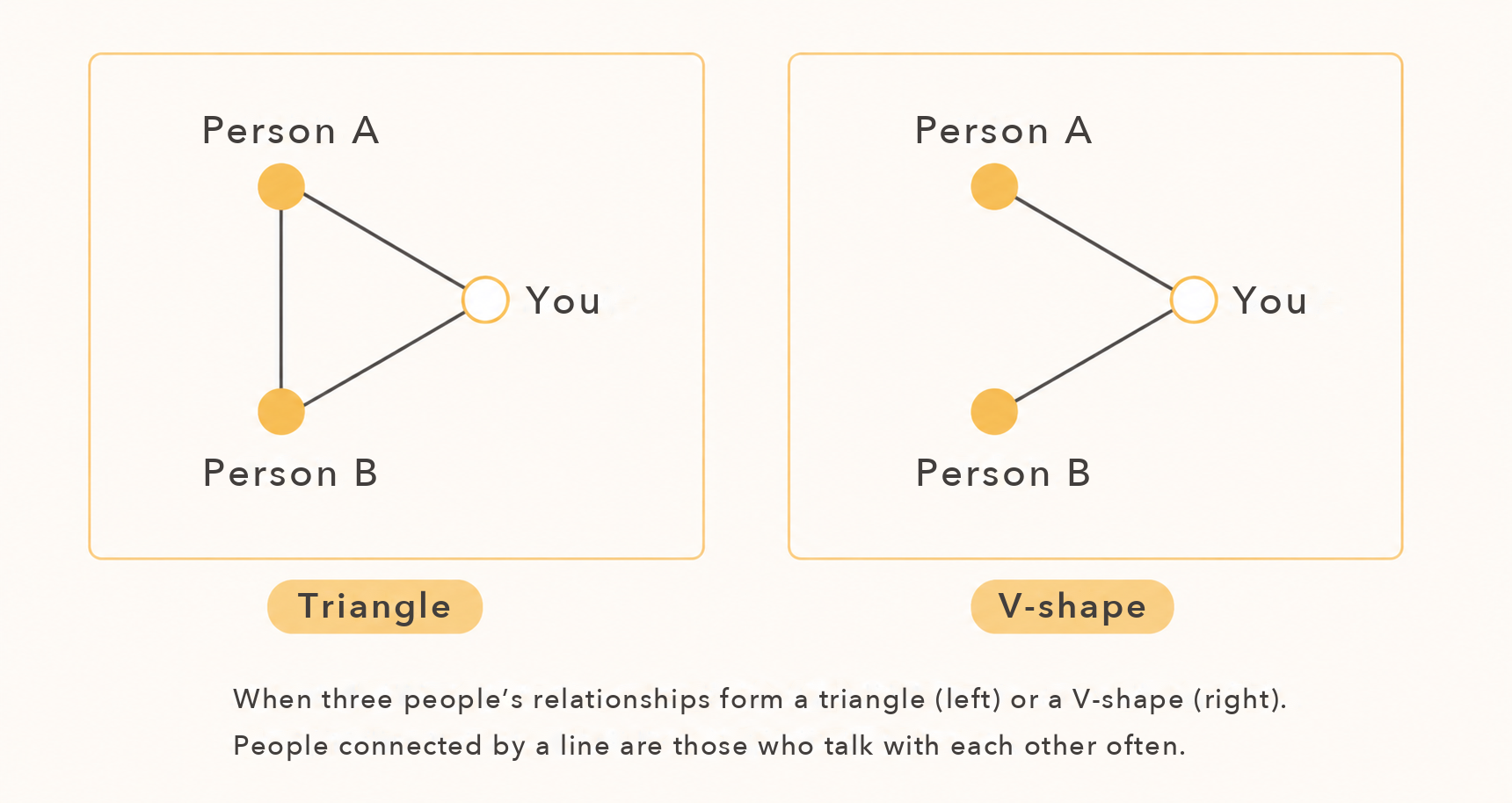
Q. How did you discover “Factor X,” which you had been searching for for so many years? Also, what does the relationship between the “V-shape” and the “triangle shape” described in this book mean?
Over many years of analyzing data, we have sought to identify the characteristics common to organizations with high levels of happiness and productivity. Initially, we considered hypotheses such as whether people who communicate frequently are happier, or whether people with many friends are more productive. However, the data was not that simple. Some people feel isolated even though they interact with many others, while others experience a high level of happiness even within a limited circle of relationships.
What became clear was that what matters is not “how connected we are,” but “how we are connected.” This book explains this concept in an easy-to-understand way using the terms “V-shape” and “triangle.”
For example, suppose I interact with both Person A and Person B. However, Person A and Person B are not connected to each other. This forms a V-shape. On the other hand, if Person A and Person B are also connected to each other and interact, this forms a triangle. Our analysis of the vast amount of data we collected revealed that this difference is significant. People and organizations with more triangular relationships in their social circles tended to show higher levels of happiness, engagement, and productivity.
Of course, that alone doesn’t explain everything. Every industry, culture, and organization is different. However, transcending those differences, we consistently observed that organizations with more triangular relationships tended to demonstrate higher levels of happiness, engagement, and productivity. For many years, I referred to this common factor as “Factor X.” And it was through analyzing vast amounts of data that this triangular relationship became apparent.
The reason V-shaped structures become more common is that when we try to understand complex work or organizations, we break them down. Sales, planning, human resources, accounting—or roles such as department heads, section chiefs, and staff members—organizing things this way makes them easier to understand. However, that is precisely when the V-shaped structure emerges. This is because the organizational chart itself is V-shaped. It is necessary to organize things logically and divide up responsibilities. However, if we try to run an organization based solely on this, people will only act within their own areas of responsibility. As a result, the organization’s ability to adapt to changes in the environment weakens.
On the other hand, triangles foster horizontal connections. There are people you can consult with. You can speak directly with people in different positions. You can ask for help when you’re in trouble. Having these kinds of relationships makes it easier to respond flexibly to changes in your environment and new challenges.
What’s interesting is that this triangle isn’t merely a characteristic of interpersonal relationships. We found that organizations with more triangular connections tended to have higher levels of productivity, engagement, and well-being. It wasn’t just individual ability that drove results—it was the relationships between people themselves.
I believe this is what a truly healthy society should look like. In other words, the “X factor” we’ve been searching for all these years is not an individual’s ability or personality, but rather the “triangular relationships” that form between people.
Chapter 3: Why Is Modern Society Heading Toward a V-Shaped Trajectory? The Structure of Isolation Created by Social Media and Rationality

Q. In this book, you point out that modern society itself is structured in a way that tends to foster V-shaped relationships. Why do we tend to gravitate toward V-shaped relationships rather than triangular ones if left to our own devices?
In fact, human society is fundamentally structured around triangles. In network science, there is a concept known as the “small-world network.” There is a famous study suggesting that you can connect to virtually anyone in the world through a chain of acquaintances in about six steps—but this isn’t simply because everyone is connected to everyone else.
In reality, there are countless small communities and clusters, and within them, many triangular relationships are formed. Typical examples include local communities, companies, schools, hobby groups, and industry associations. And it is through the people who serve as bridges between these communities that society as a whole is connected. Human society was originally structured this way.
However, in recent years, that structure has undergone significant changes. Social media is a prime example. When social media first emerged, many people expected it to become “a wonderful mechanism for connecting people.” In fact, early social media platforms did serve to strengthen community ties. As they evolved, however, social media took a different direction. In today’s social media, there is a clear division between those who follow and those who are followed. For example, millions of people connect with celebrities and influencers. At first glance, this appears to be a massive network, but structurally, it resembles a giant V-shape.
In fact, this phenomenon is driven by the mechanisms behind internet search and recommendation systems. A prime example is the concept of “PageRank,” which was used in Google’s search engine. PageRank is an algorithm that determines that “the more links a page has from other sites, the higher its value.” Another distinctive feature is that a page is rated even higher if it receives a link from a page that is already highly rated by many users.
In other words,
People are drawn to things that are already well-connected.
That's how it works.
In network science, this structure is called “Rich Gets Richer.” It’s a structure where those who already have more gain even more. The follower structure on social media is the same. The more popular someone is, the more attention they receive, and the more followers they gain. As a result, a massive V-shape emerges, with a large number of people clustered around a select few content creators.
I’m not saying that this system itself is bad. Search engines and social media are both extremely useful technologies. However, structurally speaking, they tend to foster V-shaped connections—where links flow in one direction—rather than triangular connections where people are linked horizontally.
As a result, rather than horizontal connections between people, a V-shaped structure—where a large number of people are attached to just a few—tends to proliferate. And within that structure, people begin to compare themselves to one another. Happiness research has shown that the more people compare themselves to others, the more likely they are to lose their sense of happiness. I believe that not comparing oneself to others is one of the key conditions for happiness.
However, today’s social media platforms are designed in a way that strongly encourages such comparisons. We see someone’s success. We see someone living a seemingly enjoyable life. We see someone being praised. This leads us to feel, “Am I still falling short?” or “Shouldn’t I be getting more recognition?” People tend to become unhappy when they compare themselves to others. While social media is a convenient and valuable tool, it also has a side that encourages people to compare themselves to others. I believe this is one of the factors that drives people toward isolation.
And in fact, this V-shape phenomenon isn’t limited to social media. Corporate organizations also tend to move in the same direction. When we try to understand complex tasks, we break them down. We organize roles and responsibilities in an effort to operate efficiently. And at that very moment, a V-shape emerges. This is because the organizational chart itself is V-shaped. Logical organization is necessary. Dividing up tasks is also necessary. The problem lies in trying to run the organization based on that alone. Dividing roles by area of responsibility is essential for carrying out work efficiently. However, if we rely solely on that structure, people’s focus narrows to their own areas of responsibility, and the organization’s collective ability to adapt to change weakens.
However, real-world society and markets do not exist in such a fragmented state. Customers’ problems span across departments. Social changes also extend beyond individual areas of responsibility. That is precisely why we must reconnect what was originally separated. Yet, the more we pursue rationality and efficiency, the more we unconsciously create V-shaped structures.
I believe this is a major challenge facing modern society. If left unchecked, both social media and organizations tend to follow a V-shaped trajectory. That is precisely why we need to consciously create a triangular structure—one in which people connect horizontally, engage in dialogue, and cultivate relationships based on mutual understanding. This forms the foundation for achieving both happiness and productivity.
Chapter 4: Can Resilient Organizations Be Created? Why Triangles Give Organizations Adaptability
Q. I understand the concept behind the Trinity Organization. However, what many business leaders are really interested in is, “How can we actually implement this in our own company?” What should business leaders focus on first in order to incorporate this triangular relationship into their organization?
First and foremost, it is important to correctly understand the very concept of a triangle. When people hear the word “triangle,” they often imagine a harmonious, close-knit, and relaxed organization. However, that is not the kind of triangle I am referring to.
A triangle is a form of organization that can adapt to change. Rather than simply following instructions, people think for themselves, take initiative, and create value beyond their assigned responsibilities. This is the kind of relationship that makes that possible. The reason this is necessary is that the demands of the world are constantly changing. Customer needs change. The market environment changes. Technology changes as well. With the advent of AI, the pace of these changes is accelerating even further.
However, many organizations are not structured to adapt easily to change. Rather, they operate by breaking down complex tasks, assigning responsibilities, and making them easier to manage. Such systems are necessary; they are essential for organizing complex matters and ensuring that day-to-day operations run smoothly.
At the same time, however, this creates a V-shaped structure. While dividing responsibilities by department improves operational efficiency, this structure alone cannot adapt to change. This is because the real-world market and society do not exist in separate, department-specific silos. Customer challenges span across departments, and environmental changes extend beyond the scope of individual responsibilities.
This is where the “Law of Requisite Variety” in cybernetics becomes important. This is a concept proposed by Ross Ashby, and
The more complex the environment, the greater the need for an equivalent level of diversity within the organization.
That's the rule.
In other words, even as the outside world undergoes complex changes, there are limits to how effectively an organization can respond by simply streamlining its internal operations. If an organization lacks the flexibility and diversity necessary to accommodate environmental changes, it cannot adapt to them. I believe this way of thinking will become extremely important in the future of organizational management.
The triangle also serves as a mechanism for fostering diversity. When people connect with one another, information flows across departments, and teams tackle challenges autonomously, the entire organization becomes capable of adapting to change.
That’s why I’m not saying that organizational charts and manuals are useless. It’s necessary to divide up responsibilities. However, once those responsibilities are divided, we must then connect them. When change occurs, it’s important to create an environment where people don’t say, “That’s not my job,” but instead think about how everyone can respond together.
To achieve this, people need to maintain connections with one another on a daily basis. Trust is built through casual conversations and offhand exchanges during lunch breaks. It is precisely because these relationships exist that people can naturally help one another when changes or problems arise.
On the other hand, casual connections alone are not enough. What’s important is to design the very act of addressing change as part of one’s job. Responding to new customer needs. Adapting to changes in the market environment. Solving cross-departmental challenges. We need to formally establish opportunities for multiple people to come together and think through these issues as part of their regular work. I believe this is extremely important. Casual connections and formal forums for responding to change.
Only when both of these elements function effectively does the triangle become a source of strength for the organization. The triangle is not meant to create a "good old boys' club." It is a mechanism for building an organization that can continuously adapt to change.
Chapter 5: Is It People or Organizational Culture That Makes a Triangle?
Q. Some people are good at connecting others. In fact, there are those who serve as the hub of a community, bringing people together and creating new initiatives. With that in mind, are there people who fit the description of “Trinity Talent”—individuals who are naturally adept at forming triangles—and would bringing such people together transform an organization?
I tend to think of this more as organizational theory than as a theory of human resources. Of course, there are people who are good at bringing people together. In fact, when such people are part of an organization, they often serve as a catalyst for connecting many others. However, the presence of such people is not the essence of the matter.
For example, if an organization has a culture that says, “Let’s stop unnecessary communication” or “Just stick to your own responsibilities,” no matter who joins, a “triangle” will never form. Conversely, if there’s a culture where people connect with one another and taking on challenges is welcomed, a “triangle” will form even without anyone possessing special talent. That’s why I believe this is primarily an issue of organizational culture.
Furthermore, while it might seem like we should simply evaluate people based on their ability to form triangles, it’s actually not that simple. For example, if we were to create something like a “Trinity Score” and start evaluating people by saying, “That person is good at forming triangles,” then obtaining that score would itself become the goal. This carries the risk of creating a new V-shaped pattern.
What matters is not evaluating any one specific person, but creating conditions where the triangle emerges across the entire organization. And the driving force behind this is “challenge.” When people take on challenges, they encounter problems that cannot be solved within their own areas of responsibility alone. This naturally leads them to collaborate with others and seek out new knowledge. As a result, the triangle begins to take shape.
In fact, there are companies that have incorporated this approach into their management practices. One example is the Marui Group.
At Marui, we use the “flow ratio” as a key metric. We continuously measure the percentage of employees who feel they are able to perform to the best of their abilities while taking on more challenging tasks, and we disclose these results as one of our management indicators. Furthermore, we place great importance on the number of times employees volunteer to take on new challenges—in other words, the number of times they “step up to the plate.”
What matters here isn't whether we succeeded or failed. It's how much we challenged ourselves. Taking on challenges inevitably brings anxiety. However, when an organization supports such efforts, people begin to take action beyond the scope of their usual responsibilities.
A "triangle" isn't something that's created by forcing people to connect. It arises naturally as people who take on challenges work together. While taking on challenges can be fun, it also brings anxiety. That's precisely why connections between people are so important.
Chapter 6: Triangles That Transcend Organizational Boundaries Strengthen Industries

Q. So far, our discussion has focused mainly on the triangle within corporate organizations. However, when we consider the roles of industry associations like ours, as well as wholesalers and intermediaries in the distribution chain, I feel that a triangle is also needed outside of these companies. What significance do these connections across organizational boundaries hold?
I believe that, ultimately, this is a personal matter. Everyone views the world through the lens of their own experiences. Even when various things are happening right before our eyes, we can only see the world through the filter of our own knowledge and experience. In psychology, this is called “framing.” In other words, we understand things within our own personal framework. That is precisely why it is so important to broaden that framework.
When you stay within an organization, that organization’s norms become the norm—departmental norms, company norms, industry norms. You start to think of them as absolute truths. But in reality, when you step outside, you’ll find people who see things from a completely different perspective. You often hear people say things like, “It wasn’t until I changed jobs that I realized how good my previous company was,” or “It wasn’t until I went abroad that I saw what makes Japan unique.” That’s because they were able to view the place they used to be from a higher vantage point.
I call this “metacognition” or “reframing.” It’s the ability to view oneself objectively. However, it’s not as simple as just reading a book to develop metacognition. It’s essential to meet different people, be exposed to different ways of thinking, and truly experience how they differ from your own. Industry associations play a significant role. You meet people you would never encounter if you were only focused on your day-to-day work. You learn about the perspectives of other companies. You engage in discussions with people from different standpoints. You gain new perspectives through lectures and study sessions. These experiences broaden your own framework. Industry associations are places that create such opportunities.
Chapter 7: What Comes After Generative AI: The New Form of Intelligence Pioneered by Creative AI "Fira"
Q. In recent years, generative AI—such as ChatGPT—has become increasingly widespread. You are currently working on the development of an AI called “Fira.” How does it differ from typical generative AI?
We call Fila “Creative AI.” In fact, AI is currently at a major turning point. While generative AI has made it possible to create natural-sounding text, I believe that “creativity” will be the next key focus. However, before we get to that, we first need to consider what creativity actually is.
I have been conducting research on creativity for many years. When people hear the word “creativity,” many imagine creating something out of nothing. However, I do not see it that way. Management scholar Peter Drucker stated, “The only functions of a business are innovation and marketing.” I consider these words to be extremely important. Companies must continuously create new value and deliver it to society. At the heart of this lies creativity.
So, what exactly is this "creation"?
The economist Joseph Schumpeter described innovation as a “new combination.” New value is created by combining existing knowledge, technology, and experience in new ways. I believe this is the essence of creativity. However, simply adding two things together does not constitute creativity. Merely piecing together what we already know does not create new value. A truly creative idea is one in which existing knowledge is linked in such a way that it gives rise to new perspectives or meanings that did not exist before.
In fact, thanks to recent advances in AI technology, we are now able to analyze these creative processes quantitatively. Current AI systems represent words and concepts as vectors in a space with thousands of dimensions. How close are two themes to one another? How much new meaning is generated when two concepts are combined? We are now able to calculate these things mathematically.
We have been conducting research on creativity for over twenty years. As a result, we have developed technology that measures and quantifies creativity itself. Filler is a creativity AI that leverages the results of this research.
The key point here is the difference from generative AI.
Today’s generative AI is exceptionally capable. However, at its core, it’s a system that predicts the word most likely to come next based on the vast amount of data it has been trained on. While it excels at generating natural-sounding text, its capabilities are fundamentally an extension of past knowledge. In fact, the breakthroughs in today’s generative AI did not result from teaching it the meanings of words or grammar. Instead, they were achieved by continuously predicting the next word based on vast amounts of text data. This is what has enabled it to reach a level where it can converse naturally with humans.
This was an incredibly significant technological innovation. However, creativity does not arise from that alone. Creativity requires a separate mechanism to generate new meaning. That is why we integrated a creativity engine into our generative AI. By incorporating this approach, Fira helps users generate new meanings and perspectives.
We are currently conducting benchmark tests on a variety of topics, including management, human resources, sales, and investment. The results show that, in terms of creativity, Fira significantly outperforms existing generative AI, with a standard score that is approximately 27 points higher.
We call this “Fourth-Generation AI.” Search engines are the first generation. Machine learning-based recommendations are the second generation. Generative AI is the third generation. And creative AI is the fourth generation.
If generative AI is “AI that creates natural-sounding text,” then creative AI is “AI that generates new meanings and ideas.” Fira is an AI developed to support that creative process.
*The end of this book features a roundtable discussion among fictional experts in various fields, created by the creative AI “Fira.” It offers a fascinating exploration of the book’s content from the perspectives of management and human resources. We encourage you to read it in the book itself.
Chapter 8: How Will AI Transform Companies? From Division of Labor to Autonomy: A Major Organizational Transformation Begins

Q. How will the evolution of AI change organizations and the way we work in the future?
When it comes to AI, I believe the most important thing isn’t “how to use it,” but “what to use it for.” Many people think that simply adding AI to their current work to improve efficiency a little is enough. But that’s not the essence of it.
There are two areas where I believe AI will have a particularly significant impact. One is creativity. The other is software development. I spoke about creativity earlier, but in terms of its impact on society as a whole, the changes in software development may be even more significant.
AI is now capable of writing programs, and its capabilities are evolving at an astonishing pace. I use AI on a daily basis while developing software, and I’m now able to develop at a speed that’s incomparable to what it used to be. What’s important is that the focus is no longer on “how to build it,” but rather on “what to build.” AI assists with the implementation itself. As a result, what remains for humans to address are the questions of what we want to achieve and what value we want to create. I believe this shift will significantly transform organizations themselves.
The reason we’ve always divided labor in the first place is that there are limits to what a single person can know. Sales. Finance. Research and Development. Human Resources. The organization functioned because each person gained deep expertise in their respective fields and combined their results. However, AI is changing that premise.
AI possesses a vast amount of knowledge. When humans and AI work together as a single team, the scope of knowledge and capabilities that a single person can handle expands dramatically. As a result, there is no longer a need to confine people to narrow areas of responsibility or specialized departments.
Recently, the term “one-person unicorn” has emerged. By leveraging AI, even small teams or individuals are beginning to create value on a scale that was previously only possible for large corporations.
Of course, large-scale social infrastructure and major projects require organizations in which many people collaborate. However, the nature of these organizations will change significantly. They will likely shift away from the hierarchical, V-shaped structures of the past toward flatter organizations in which autonomous individuals are organically connected.
I believe that a new kind of individual—a fusion of humans and AI—will emerge. And I believe we will see a society in which these individuals create together while connected in a triangular network. AI does not render humans obsolete. Quite the opposite, in fact. People who can master AI and act autonomously will wield even greater power than ever before.
On the other hand, a significant gap will likely emerge between such organizations and those that continue to remain confined within the framework of traditional roles and division of labor. Within companies, the number of people who work autonomously while leveraging AI will increase, and these individuals will form triangular connections to collaborate with one another. I believe that such organizations will possess significant competitive advantage in the coming era. We are currently at a major turning point where intellectual creativity and AI are converging.
In the coming era, if the very act of protecting existing organizations becomes the goal in itself, we risk being left behind by change. That is precisely why it is so important to embrace change and foster relationships that connect autonomous individuals.
I believe that, precisely because we are in the age of AI, the value of the “Trinity”—that is, triangular relationships—will only increase. In that sense, AI can be described as a technology that accelerates the development of triangular organizations. And I feel the same way about the future itself. The future is not something predetermined. If everything were decided from the very beginning, that would amount to fatalism or determinism.
Every day, we make choices and create the future by generating new value. In fact, this way of thinking is deeply connected to quantum theory, which was established about 100 years ago. At the heart of quantum theory lies the “Uncertainty Principle*” proposed by Werner Heisenberg. According to this principle, the future is not fixed to a single outcome; rather, a variety of possibilities are always open.
I believe that creation, organizations, and AI are all the same. What matters is not predicting a predetermined future, but discovering new possibilities and turning them into reality. That is why people connect with one another and collaborate with AI to create a new future. I believe this process will become increasingly important going forward.
What struck me most about Professor Yano’s talk was the point that an organization’s strength is not determined solely by individual ability, but is greatly influenced by “relationships between people.”
In our efforts to improve efficiency and streamline operations, we have broken down tasks and divided roles into smaller, more specific parts. However, the V-shaped structure that results from this can sometimes weaken our ability to adapt to change and weaken the bonds between people.
On the other hand, the “triangular relationship” is not merely about getting along well. It is a framework that allows people in different positions to connect, learn from one another, and work together to embrace change. I felt that this concept applies not only within companies but also to industry associations and local communities.
What I found even more interesting was the perspective that, as we move further into the AI era, the value of human connections and creativity will only increase. Perhaps it is precisely because we are in an era where AI supports knowledge and implementation that the ability to ask questions, collaborate with others, and create new possibilities becomes even more important.
The Tokyo Knitwear Wholesalers’ Association is also one of these “triangular spaces” where people from different companies come together, giving rise to new perspectives and challenges. We hope this interview will serve as an opportunity to reflect on the future of organizations and industries.
“Why do people become isolated?” “Why do differences in organizational vitality arise?” This book offers new answers to these questions from the perspectives of data science and network science. It is a must-read for anyone involved in organizational management.
* The Law of Requisite Variety
Ross Ashby (1903–1972)
A pioneer in cybernetics (the science of control and communication). He proposed the “Law of Necessary Diversity,” which states that organizations and living organisms require a certain level of diversity to adapt to changing environments. This concept has become one of the foundational theories of modern organizational theory, network science, and AI research.
The Law of Necessary Diversity, proposed by Ross Ashby, is the concept that “the more complex an environment is, the greater the degree of diversity required within the organization or system that responds to it.” It demonstrates that diverse perspectives and the ability to respond flexibly become increasingly important in times of rapid change.
* Uncertainty Principle
Werner Heisenberg (1901–1976)
A German theoretical physicist and one of the founders of quantum mechanics. His “Uncertainty Principle,” published in 1927, demonstrated that it is impossible to simultaneously measure a particle’s position and momentum with absolute precision. This discovery challenged the traditional deterministic worldview—which held that “if the current state is fully known, the future can be fully predicted”—and suggested that multiple possibilities inherently exist for the future. It had a profound influence on modern physics.
/ Tag
Back to the KNITTERESTING Home Page